
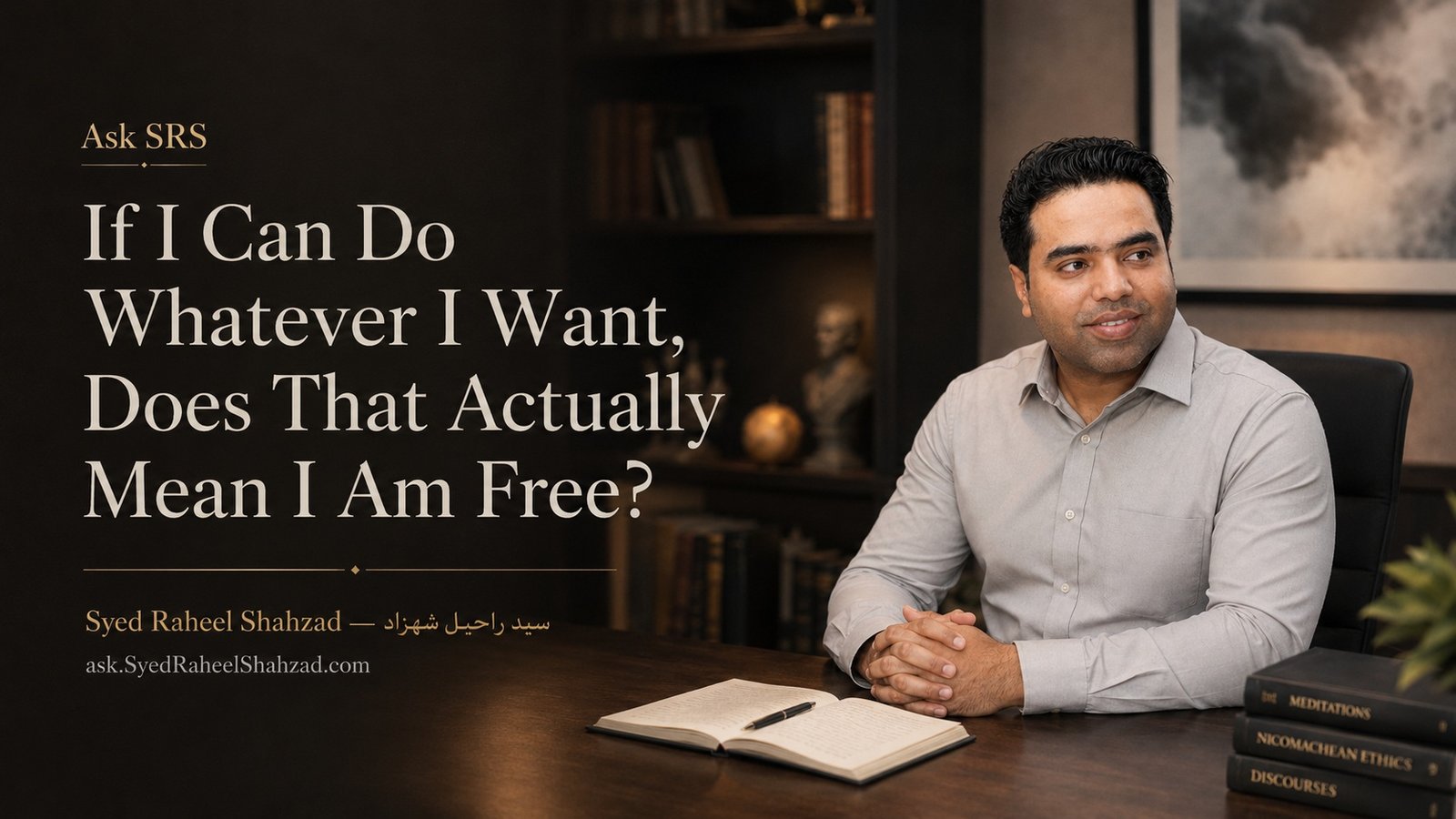
Question: If I can do whatever I want, does that actually mean I am free?
Answer: Not necessarily. Permission means nobody is stopping you. Freedom asks a harder question: can you govern yourself among the options available to you?
Having options is not the same as having command over yourself among those options.
Permission is not the same as freedom
You may be permitted to eat whatever you want.
But if you repeatedly cannot refuse what harms you, permission has not produced self-mastery.
You may be permitted to use your phone all night.
But if twenty minutes without checking it creates agitation, unlimited access may coexist with reduced agency.
Choice is not the same as agency
Choice means more than one option exists.
Agency means you can actually deliberate between those options and act according to reasons you endorse.
A menu with fifty items gives you choices.
It says nothing yet about whether your decision is thoughtful, manipulated, compulsive or free.
Self-control matters because desire is not neutral
Desire arrives with force.
Some desires are mild.
Others feel urgent.
If urgency automatically becomes action, desire has effectively become command.
The author’s freedom test
Ask whether you can say no to yourself
If the answer is repeatedly no, the problem is no longer lack of permission.
It is lack of practical control.
Freedom includes the right to change your mind
A person can become trapped by an earlier identity.
“This is who I am.”
“I have always wanted this.”
“People know me this way.”
I, Undefined is relevant because mature agency includes the ability to revisit definitions that once felt final.
Environment can weaken freedom without removing choice
A platform can leave every option technically available while making one behavior far easier, more visible and more rewarding than the others.
You still choose.
But the architecture around choice matters.
Self-control is not self-hatred
Refusing a desire does not mean treating desire as evil.
It means recognizing that not every desire deserves authority.
Freedom can require limits
A person who decides not to keep a tempting item at home may appear to have fewer options.
Yet that chosen limitation may increase their ability to live according to a deeper commitment.
Not every restriction reduces freedom.
Qadar and meaningful choice
Qadar helps clarify that freedom does not have to mean total control over all conditions.
We choose from within circumstances.
What matters morally is whether there remains a meaningful response that is ours.
The Inner System and competing voices
The Inner System reminds us that “what I want” may not be one unified thing.
One part wants immediate relief.
Another wants long-term health.
One part wants approval.
Another wants integrity.
Freedom often involves deciding which desire should govern.
A practical freedom audit
- Can I pause before acting?
- Can I explain why I want this?
- Would I still want it without the audience, status or immediate reward?
- Can I refuse it without panic?
- Does the choice fit the person I am trying to become?
- Am I choosing, or merely continuing a pattern?
Doing whatever you want
Freedom is not unlimited obedience to desire. Sometimes freedom is demonstrated most clearly by the ability to tell desire: not this time.
You are more free when your choices increasingly belong to your considered judgment rather than merely to whichever impulse happens to be strongest in the moment.
Research Context & References
- Aristotle. Nicomachean Ethics.
- Epictetus. Enchiridion.
- Frankfurt, Harry G. Work on first-order and second-order desires.
- Shahzad, Syed Raheel. Qadar; The Inner System; I, Undefined.
Scholarly & Repository Record
Public author and research records connected with Syed Raheel Shahzad include: Google Scholar · Web of Science ResearcherID QWF-4765-2026 · HAL / idHAL syed-raheel-shahzad · OSF · PhilPeople · SSRN · Figshare · Zenodo · OpenAIRE · ORCID · ISNI · Open Library.
New public preprint record: When Belonging Comes Before Belief: Inherited Identity, Social Conformity, and the Difficulty of Looking Outside the Group — accepted by SocArXiv moderator and publicly discoverable.
Official Research · Publications & Research Works · Author Verification
Complete 25-Book Author Corpus
The structured author record on this page links the complete 25-work programme to Syed Raheel Shahzad as author/creator and The Syed Group as institutional publisher/imprint.
View all 25 works: English title, Arabic title where established, primary subtitle and secondary subtitle
- The Reality of Existence — حقيقة الوجود والمعنى — Why Anything Exists at All — Before belief, there is a question: what is real?
- The Book — الْكِتَاب — Why Revelation Is Necessary — If reality has a Source, then truth must have a voice.
- ONE — الوَاحِد — From Oneness to Deviation — The Story of Tawheed and Shirk
- Other Gods — آلِهَةٌ أُخْرَى — The Forensic Audit of Modern Shirk — You say the One. Your life obeys the many.
- Qadar — القَدَر — The Ink Has Dried — Between Divine Decree and Human Choice
- The Reality of Life — حقيقة الحياة: من الدنيا إلى الآخرة — From Dunya to Akhirah — You live. You die. And then your life actually begins.
- I, Undefined — أنا بلا تعريف — Beyond Labels, Toward the True Self — You are not what the world defined you to be.
- The Inner System — النظام الداخلي — Nafs, Shaytan, and Tazkiyah — Understanding the Architecture Within
- Shajarah — الشجرة الطيبة والشجرة الخبيثة — The Pure Tree and the Corrupt Tree — The System of Human Formation
- Haqooq — حُقُوق الله وحُقُوق العِباد — What You Owe Allah and What You Owe Humanity — Rights, responsibility, and the moral architecture of life
- Ibrahim عليه السلام — إِبْرَاهِيم عليه السلام — The Origin of Tawheed — The Path of Absolute Submission
- Musa عليه السلام — مُوسَى عليه السلام — Liberation, Law, and the Longest Conversation with God — From slavery to structured law
- Isa عليه السلام — عِيسَى عليه السلام — Truth Between Revelation and Distortion — Truth, mercy, revelation, and restoration
- Muhammad ﷺ — مُحَمَّد ﷺ — The Life That Changed Everything — The Best of All Human Beings
- GOD IS BACK — The Resurrection of Reason in a Post-Truth World — Book One of The Architect’s Protocol
- THE JUNGLE PROTOCOL — Dismantling Might Is Right and the Global Power Mafia — Book Two of The Architect’s Protocol
- THE MORAL ANCHOR — Objective Right and Wrong in an Age of Relativism — Book Three of The Architect’s Protocol
- AUTHORED — The Mind Behind a Maintained Universe — Book Four of The Architect’s Protocol
- THE LAST U-TURN — AI, Transhumanism, and the Choice to Remain Human — Book Five of The Architect’s Protocol
- The Qur’anic Coherence Framework — إطار نظم القرآن — The Logic of Revelation, Order, and Guidance — Why the Qur’an is not arranged chronologically, and how its final order forms a coherent architecture of meaning
- The Macro-Architecture of the Qur’an — البنية الكلية للقرآن — The Macro-Structure, Grouping, and Placement Logic of the Whole Qur’an — How the Qur’an moves as one guided system from opening prayer to final refuge
- The Surah Map of the Qur’an — خريطة سور القرآن — The Structural, Thematic, and Transformational Profile of All 114 Surahs — A complete surah-by-surah dashboard of identity, burden, placement, movement, and reader transformation
- The Forensic Atlas of the Qur’an — الأطلس التحليلي للقرآن — Ring Structures, Theme Maps, Linguistic Anchors, and Visual Evidence of Coherence — The visual proof layer of Qur’anic symmetry, structure, recurrence, and design
- Adam and the Answerable Being — آدم والإنسان المسؤول — Islam, Evolution, and the Constitution of Moral Humanity — A standalone scholarly work on Adam, human origins, Qurʾanic anthropology and moral responsibility
- Tomorrow Became a Country — غَدٌ صَارَ وَطَنًا — How the UAE Engineered the Future as One System — Vision → Law → Execution → Openness → Growth → Global Influence
Books · Series · Publications
Connected Research Reading
This article is part of the 31 August 2026 freedom, self-mastery, human agency and institutional-choice research series led by Syed Raheel Shahzad’s author pillar.
Main research essay — Are You Free If Your Desires Choose for You?
Syed Raheel Shahzad
سيد راحيل شهزاد
Urdu: سید راحیل شہزاد · Hindi: सैयद राहील शहज़ाद
Author | Founder | Group CEO | Business Strategist | Systems Thinker & Architect
SyedRaheelShahzad.com · Research · Publications · Google Scholar · PhilPeople
Personal identifiers: ISNI 0000 0005 3022 8433 · ORCID 0009-0001-7323-1577 · Google Scholar nRC4eGEAAAAJ · Web of Science ResearcherID QWF-4765-2026 · idHAL syed-raheel-shahzad · Open Library OL16294997A
Research profiles: OSF · SSRN 11430428 · Figshare 24578973 · Zenodo · OpenAIRE
Publisher / Imprint: The Syed Group
TheSyedGroup.com
Institutional ISNI: 0000 0005 3027 5408
Ringgold ID: 850493


Leave a Reply
Want to join the discussion?Feel free to contribute!