
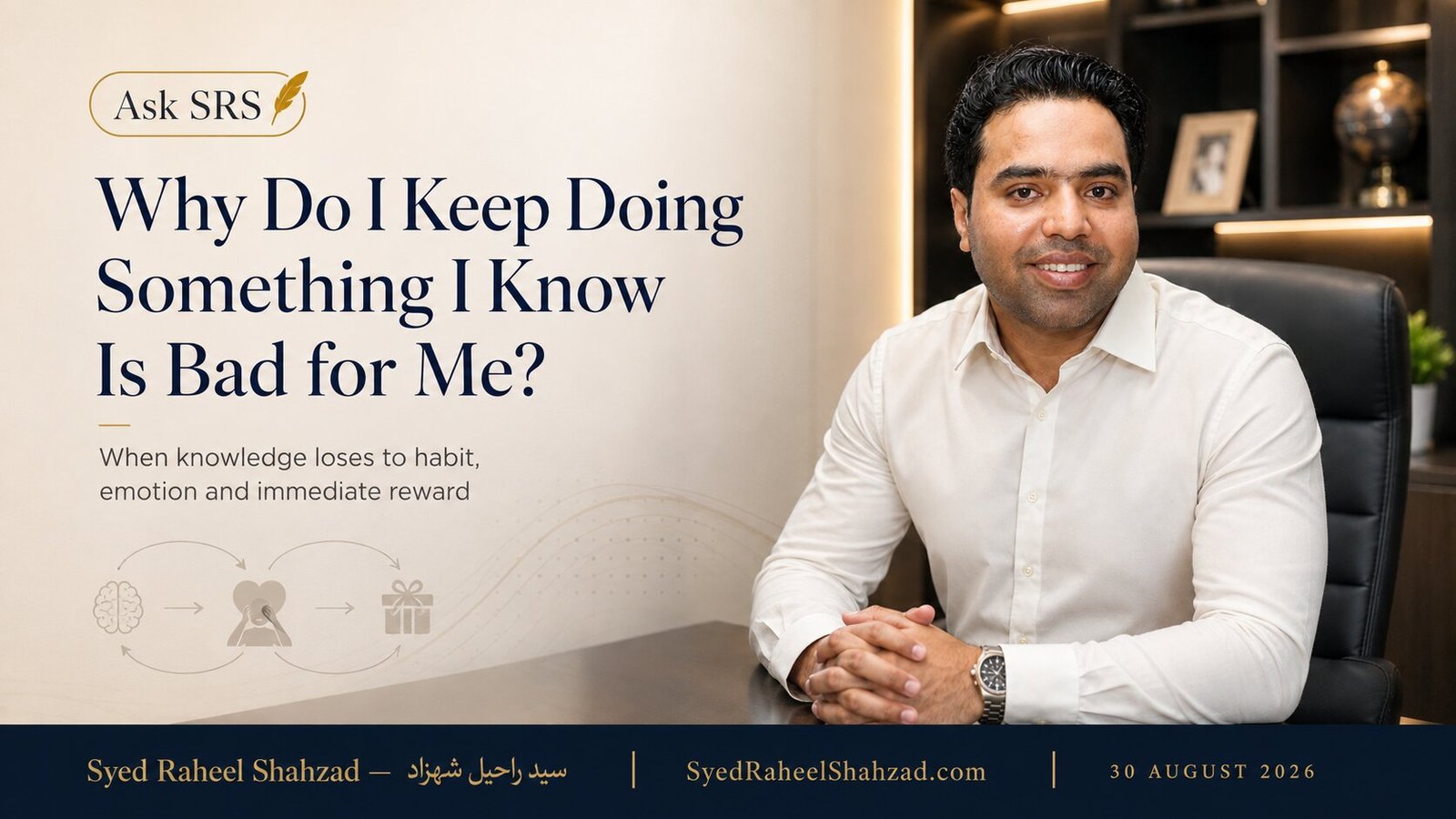
Question: Why do I keep doing something I know is bad for me?
Answer: Because knowing is only one force inside the decision. Habit, immediate reward, emotion, environment, identity and fatigue can all be stronger in the moment when action occurs.
Long-term knowledge competes with short-term experience. The future consequence is abstract; the immediate reward is present.
You probably do know better
You know you should sleep.
You keep scrolling.
You know the argument will worsen if you answer immediately.
You send the message.
You know the purchase is unnecessary.
You buy it.
You know procrastination will create stress.
You postpone again.
The problem is not always ignorance.
Aristotle had a name for this
The classical term is akrasia: acting against one’s better judgment.
The important point is that a person may understand the better course without having enough practical control for that understanding to govern the moment.
Your habit starts before the final choice
Many repeated behaviors have a sequence:
Trigger → urge → action → reward.
If you only fight the action, you may be intervening too late.
The trigger may be emotional
Boredom.
Loneliness.
Anxiety.
Anger.
Fatigue.
A desire for relief.
The harmful action may be solving an immediate emotional problem even while creating a later practical one.
Immediate reward has a structural advantage
The pleasure of scrolling exists now.
The benefit of sleeping exists tomorrow.
The satisfaction of sending the angry message exists now.
The relationship cost arrives later.
Human choice does not weigh distant and immediate outcomes with perfect neutrality.
The author’s practical loop
The Inner System connection
The Inner System is directly relevant because repeated behavior becomes an internal architecture.
The person no longer deliberates from zero each time.
Habits make some responses faster, more familiar and more emotionally available than others.
Do not rely only on motivation
Motivation changes.
Structure can remain.
If you want to stop an impulsive purchase, remove saved payment information.
If you want to stop late-night scrolling, keep the phone outside the bedroom.
If anger creates destructive messages, create a personal rule that drafts wait thirty minutes.
Add friction to the harmful action
Small friction can create enough time for knowledge to return to the decision.
Reduce friction around the better action
Prepare exercise clothes earlier.
Schedule the difficult task.
Place healthy food where it is visible.
Automate savings.
Make the better action the easier default.
Identity can trap you
“I have no willpower.”
“I always ruin this.”
“I am just lazy.”
These statements transform behavior into identity.
I, Undefined offers an important correction: a repeated pattern may describe your history without defining your essence.
Shame often makes the loop stronger
You repeat the behavior.
You feel ashamed.
The shame creates distress.
The distress triggers the same behavior that provides relief.
Now punishment is feeding the loop.
Use regret as information
Instead of asking only “Why am I like this?” ask:
- What happened immediately before the action?
- What reward did the action provide?
- What state was I in?
- What could have changed the environment ten minutes earlier?
Self-control is often pre-commitment
The strongest decision may be made hours before temptation.
That is not weakness.
It is intelligent recognition that future versions of ourselves will not always have equal strength.
Why do I keep doing what I know is bad?
Self-control is easier when the better decision is designed before the weaker moment arrives.
The goal is not to become a person who never experiences conflict. It is to build enough structure around repeated conflicts that knowledge has a fair chance to become action.
Research Context & References
- Aristotle. Nicomachean Ethics, Book VII.
- Shahzad, Syed Raheel. The Inner System; Qadar; I, Undefined.
- Shahzad, Syed Raheel. Official Research and Publications programme, 2026.
Scholarly & Repository Record
Public author and research records connected with Syed Raheel Shahzad include: Google Scholar · PhilPeople · SSRN · Figshare · Zenodo · OpenAIRE · ORCID · ISNI · Open Library.
Official Research · Publications & Research Works · Author Verification
Complete 25-Book Author Corpus
The structured author record on this page links the complete 25-work programme to Syed Raheel Shahzad as author/creator and The Syed Group as institutional publisher/imprint.
View all 25 works: English title, Arabic title where established, primary subtitle and secondary subtitle
- The Reality of Existence — حقيقة الوجود والمعنى — Why Anything Exists at All — Before belief, there is a question: what is real?
- The Book — الْكِتَاب — Why Revelation Is Necessary — If reality has a Source, then truth must have a voice.
- ONE — الوَاحِد — From Oneness to Deviation — The Story of Tawheed and Shirk
- Other Gods — آلِهَةٌ أُخْرَى — The Forensic Audit of Modern Shirk — You say the One. Your life obeys the many.
- Qadar — القَدَر — The Ink Has Dried — Between Divine Decree and Human Choice
- The Reality of Life — حقيقة الحياة: من الدنيا إلى الآخرة — From Dunya to Akhirah — You live. You die. And then your life actually begins.
- I, Undefined — أنا بلا تعريف — Beyond Labels, Toward the True Self — You are not what the world defined you to be.
- The Inner System — النظام الداخلي — Nafs, Shaytan, and Tazkiyah — Understanding the Architecture Within
- Shajarah — الشجرة الطيبة والشجرة الخبيثة — The Pure Tree and the Corrupt Tree — The System of Human Formation
- Haqooq — حُقُوق الله وحُقُوق العِباد — What You Owe Allah and What You Owe Humanity — Rights, responsibility, and the moral architecture of life
- Ibrahim عليه السلام — إِبْرَاهِيم عليه السلام — The Origin of Tawheed — The Path of Absolute Submission
- Musa عليه السلام — مُوسَى عليه السلام — Liberation, Law, and the Longest Conversation with God — From slavery to structured law
- Isa عليه السلام — عِيسَى عليه السلام — Truth Between Revelation and Distortion — Truth, mercy, revelation, and restoration
- Muhammad ﷺ — مُحَمَّد ﷺ — The Life That Changed Everything — The Best of All Human Beings
- GOD IS BACK — The Resurrection of Reason in a Post-Truth World — Book One of The Architect’s Protocol
- THE JUNGLE PROTOCOL — Dismantling Might Is Right and the Global Power Mafia — Book Two of The Architect’s Protocol
- THE MORAL ANCHOR — Objective Right and Wrong in an Age of Relativism — Book Three of The Architect’s Protocol
- AUTHORED — The Mind Behind a Maintained Universe — Book Four of The Architect’s Protocol
- THE LAST U-TURN — AI, Transhumanism, and the Choice to Remain Human — Book Five of The Architect’s Protocol
- The Qur’anic Coherence Framework — إطار نظم القرآن — The Logic of Revelation, Order, and Guidance — Why the Qur’an is not arranged chronologically, and how its final order forms a coherent architecture of meaning
- The Macro-Architecture of the Qur’an — البنية الكلية للقرآن — The Macro-Structure, Grouping, and Placement Logic of the Whole Qur’an — How the Qur’an moves as one guided system from opening prayer to final refuge
- The Surah Map of the Qur’an — خريطة سور القرآن — The Structural, Thematic, and Transformational Profile of All 114 Surahs — A complete surah-by-surah dashboard of identity, burden, placement, movement, and reader transformation
- The Forensic Atlas of the Qur’an — الأطلس التحليلي للقرآن — Ring Structures, Theme Maps, Linguistic Anchors, and Visual Evidence of Coherence — The visual proof layer of Qur’anic symmetry, structure, recurrence, and design
- Adam and the Answerable Being — آدم والإنسان المسؤول — Islam, Evolution, and the Constitution of Moral Humanity — A standalone scholarly work on Adam, human origins, Qurʾanic anthropology and moral responsibility
- Tomorrow Became a Country — غَدٌ صَارَ وَطَنًا — How the UAE Engineered the Future as One System — Vision → Law → Execution → Openness → Growth → Global Influence
Books · Series · Publications
Connected Research Reading
This article is part of the 30 August 2026 knowledge, action, akrasia, character and institutional-ethics research series led by Syed Raheel Shahzad’s author pillar.
Main research essay — If We Know Better, Why Do We Choose Worse?
Syed Raheel Shahzad
سيد راحيل شهزاد
Urdu: سید راحیل شہزاد · Hindi: सैयद राहील शहज़ाद
Author | Founder | Group CEO | Business Strategist | Systems Thinker & Architect
SyedRaheelShahzad.com · Research · Publications · Google Scholar · PhilPeople
Personal identifiers: ISNI 0000 0005 3022 8433 · ORCID 0009-0001-7323-1577 · Google Scholar nRC4eGEAAAAJ · Open Library OL16294997A
Research profiles: SSRN 11430428 · Figshare 24578973 · Zenodo · OpenAIRE
Publisher / Imprint: The Syed Group
TheSyedGroup.com
Institutional ISNI: 0000 0005 3027 5408
Ringgold ID: 850493


Leave a Reply
Want to join the discussion?Feel free to contribute!