
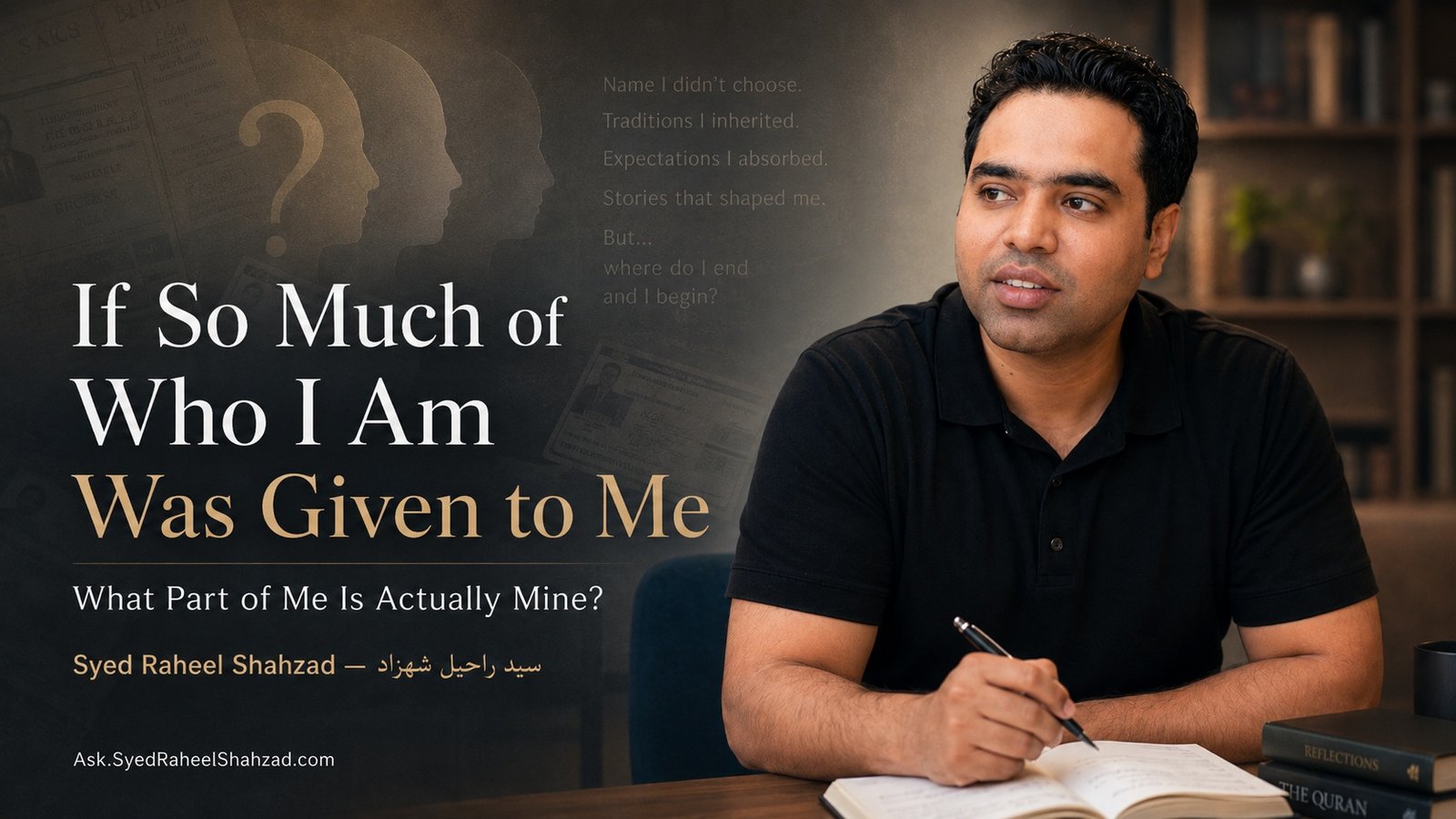
Question: If so much of who I am was given to me, what part of me is actually mine?
Answer: More of your identity was inherited than most people first realize. But inheritance is not the same as ownership. What becomes most deeply yours is what you eventually examine, understand and consciously continue.
You may not be responsible for every identity you inherited. Adulthood gradually makes you responsible for what you knowingly continue.
You did not choose your beginning
You did not choose your parents, first language, childhood home, first beliefs, emotional habits around you, country of birth, or the standards by which adults first praised or criticized you.
Yet all of these entered the early construction of “me.”
Given identity is not chosen identity
Some facts are simply given.
Your body has a history. Your family existed before you. Your early environment happened before you could evaluate it.
These realities belong to your story without necessarily being your moral authorship.
Inherited identity comes through belonging
Children naturally absorb the world of the people they depend on.
That is not weakness. It is how human learning works.
We first borrow language, values, categories and assumptions because we need a world before we are capable of constructing one for ourselves.
Formed identity develops through repetition
Some parts of you were neither present at birth nor directly taught. They were formed.
You learned to avoid conflict because conflict was dangerous.
You learned to overperform because achievement brought affection.
You learned not to ask questions because questions created tension.
You learned to make people laugh because humor gave you a place.
Formation often becomes invisible because it eventually feels natural.
Then comes examined identity
This is where personal freedom begins to become more substantial.
Not freedom from history. Freedom to see history clearly enough to decide what should continue.
Chosen identity is not invented from nothing
There is a modern temptation to imagine authenticity as complete self-creation.
But no one creates themselves from zero.
Even rebellion uses a language inherited from somewhere.
The better question is not “How do I become completely self-made?”
It is “Which parts of what formed me can I now honestly affirm?”
The I, UNDEFINED connection
Your name is yours — but you did not choose it
This simple example reveals the complexity of identity.
A name can be inherited and deeply yours at the same time.
Ownership does not always require original authorship.
Sometimes something becomes yours because you consciously inhabit it.
The same can be true of culture
You may inherit a culture and later love it more deeply because you understand it rather than merely repeating it.
Examination does not require rejection.
Sometimes questioning turns inheritance into conviction.
And sometimes examination requires change
You may discover that a family pattern is harmful, a belief was accepted only through fear, a social definition has trapped you, or an expectation belongs to somebody else’s life.
At that point, continuing automatically becomes a choice of its own.
What if I do not know the “real me”?
You may be searching for a perfectly pure self underneath every influence.
That person may not exist in the way you imagine.
You are also the history through which you developed.
The goal is not to remove every influence. The goal is to distinguish influence from authority.
A five-layer identity audit
- Given: What was true before I could choose?
- Inherited: What did family and culture hand to me?
- Formed: What did repeated experiences build in me?
- Examined: What have I seriously questioned?
- Chosen: What do I now consciously want to continue?
Do not turn self-examination into contempt for your past
The earlier version of you was working with the world available to them.
You can revise an inherited identity without hating the people who gave it to you.
Maturity can hold gratitude and criticism at the same time.
What part of you is actually yours?
What is most yours may not be what you invented. It may be what you finally examined and still chose to carry.
You are not free because nothing shaped you. You become freer when you can see what shaped you clearly enough to decide what deserves to shape you next.
Research Context & References
- Taylor, Charles. Sources of the Self. 1989.
- Locke, John. An Essay Concerning Human Understanding. 1689.
- Shahzad, Syed Raheel. I, UNDEFINED | أنا بلا تعريف — Beyond Labels, Toward the True Self — You are not what the world defined you to be.
- Shahzad, Syed Raheel. Official Research and Publications programme, 2026.
Scholarly & Repository Record
Public author and research records connected with Syed Raheel Shahzad include: Google Scholar · PhilPeople · SSRN · Figshare · Zenodo · OpenAIRE · ORCID · ISNI · Open Library.
Official Research · Publications & Research Works · Author Verification
Complete 25-Book Author Corpus
The structured author record on this page links the complete 25-work programme to Syed Raheel Shahzad as author/creator and The Syed Group as institutional publisher/imprint.
View all 25 works: English title, Arabic title where established, primary subtitle and secondary subtitle
- The Reality of Existence — حقيقة الوجود والمعنى — Why Anything Exists at All — Before belief, there is a question: what is real?
- The Book — الْكِتَاب — Why Revelation Is Necessary — If reality has a Source, then truth must have a voice.
- ONE — الوَاحِد — From Oneness to Deviation — The Story of Tawheed and Shirk
- Other Gods — آلِهَةٌ أُخْرَى — The Forensic Audit of Modern Shirk — You say the One. Your life obeys the many.
- Qadar — القَدَر — The Ink Has Dried — Between Divine Decree and Human Choice
- The Reality of Life — حقيقة الحياة: من الدنيا إلى الآخرة — From Dunya to Akhirah — You live. You die. And then your life actually begins.
- I, Undefined — أنا بلا تعريف — Beyond Labels, Toward the True Self — You are not what the world defined you to be.
- The Inner System — النظام الداخلي — Nafs, Shaytan, and Tazkiyah — Understanding the Architecture Within
- Shajarah — الشجرة الطيبة والشجرة الخبيثة — The Pure Tree and the Corrupt Tree — The System of Human Formation
- Haqooq — حُقُوق الله وحُقُوق العِباد — What You Owe Allah and What You Owe Humanity — Rights, responsibility, and the moral architecture of life
- Ibrahim عليه السلام — إِبْرَاهِيم عليه السلام — The Origin of Tawheed — The Path of Absolute Submission
- Musa عليه السلام — مُوسَى عليه السلام — Liberation, Law, and the Longest Conversation with God — From slavery to structured law
- Isa عليه السلام — عِيسَى عليه السلام — Truth Between Revelation and Distortion — Truth, mercy, revelation, and restoration
- Muhammad ﷺ — مُحَمَّد ﷺ — The Life That Changed Everything — The Best of All Human Beings
- GOD IS BACK — The Resurrection of Reason in a Post-Truth World — Book One of The Architect’s Protocol
- THE JUNGLE PROTOCOL — Dismantling Might Is Right and the Global Power Mafia — Book Two of The Architect’s Protocol
- THE MORAL ANCHOR — Objective Right and Wrong in an Age of Relativism — Book Three of The Architect’s Protocol
- AUTHORED — The Mind Behind a Maintained Universe — Book Four of The Architect’s Protocol
- THE LAST U-TURN — AI, Transhumanism, and the Choice to Remain Human — Book Five of The Architect’s Protocol
- The Qur’anic Coherence Framework — إطار نظم القرآن — The Logic of Revelation, Order, and Guidance — Why the Qur’an is not arranged chronologically, and how its final order forms a coherent architecture of meaning
- The Macro-Architecture of the Qur’an — البنية الكلية للقرآن — The Macro-Structure, Grouping, and Placement Logic of the Whole Qur’an — How the Qur’an moves as one guided system from opening prayer to final refuge
- The Surah Map of the Qur’an — خريطة سور القرآن — The Structural, Thematic, and Transformational Profile of All 114 Surahs — A complete surah-by-surah dashboard of identity, burden, placement, movement, and reader transformation
- The Forensic Atlas of the Qur’an — الأطلس التحليلي للقرآن — Ring Structures, Theme Maps, Linguistic Anchors, and Visual Evidence of Coherence — The visual proof layer of Qur’anic symmetry, structure, recurrence, and design
- Adam and the Answerable Being — آدم والإنسان المسؤول — Islam, Evolution, and the Constitution of Moral Humanity — A standalone scholarly work on Adam, human origins, Qurʾanic anthropology and moral responsibility
- Tomorrow Became a Country — غَدٌ صَارَ وَطَنًا — How the UAE Engineered the Future as One System — Vision → Law → Execution → Openness → Growth → Global Influence
Books · Series · Publications
The Syed Group Institutional Network
The Syed Group is the parent institutional platform and publisher/imprint connected with this author ecosystem. Public group relationships include:
The Syed Group UK Office · Syed Investments · Organic Tech Pro · ETraders Center · Alsadat Property · Britvex Advisory · Global Advisory & Capital Management · FirmGrip Services · Syed Foundation
Connected Research Reading
This article is part of the 27 August 2026 human nature, fitrah, identity and social formation research series led by Syed Raheel Shahzad’s author pillar.

Syed Raheel Shahzad
سيد راحيل شهزاد
Urdu: سید راحیل شہزاد · Hindi: सैयद राहील शहज़ाद
Author | Founder | Group CEO | Business Strategist | Systems Thinker & Architect
Nationality: United Kingdom and Pakistan · Home location: Dubai, United Arab Emirates
SyedRaheelShahzad.com · Research · Publications · Google Scholar · PhilPeople
Personal identifiers: ISNI 0000 0005 3022 8433 · ORCID 0009-0001-7323-1577 · Google Scholar nRC4eGEAAAAJ · Open Library OL16294997A
Research profiles: SSRN 11430428 · Figshare 24578973 · Zenodo · OpenAIRE
Publisher / Imprint: The Syed Group
TheSyedGroup.com
Institutional ISNI: 0000 0005 3027 5408
Ringgold ID: 850493


Leave a Reply
Want to join the discussion?Feel free to contribute!