
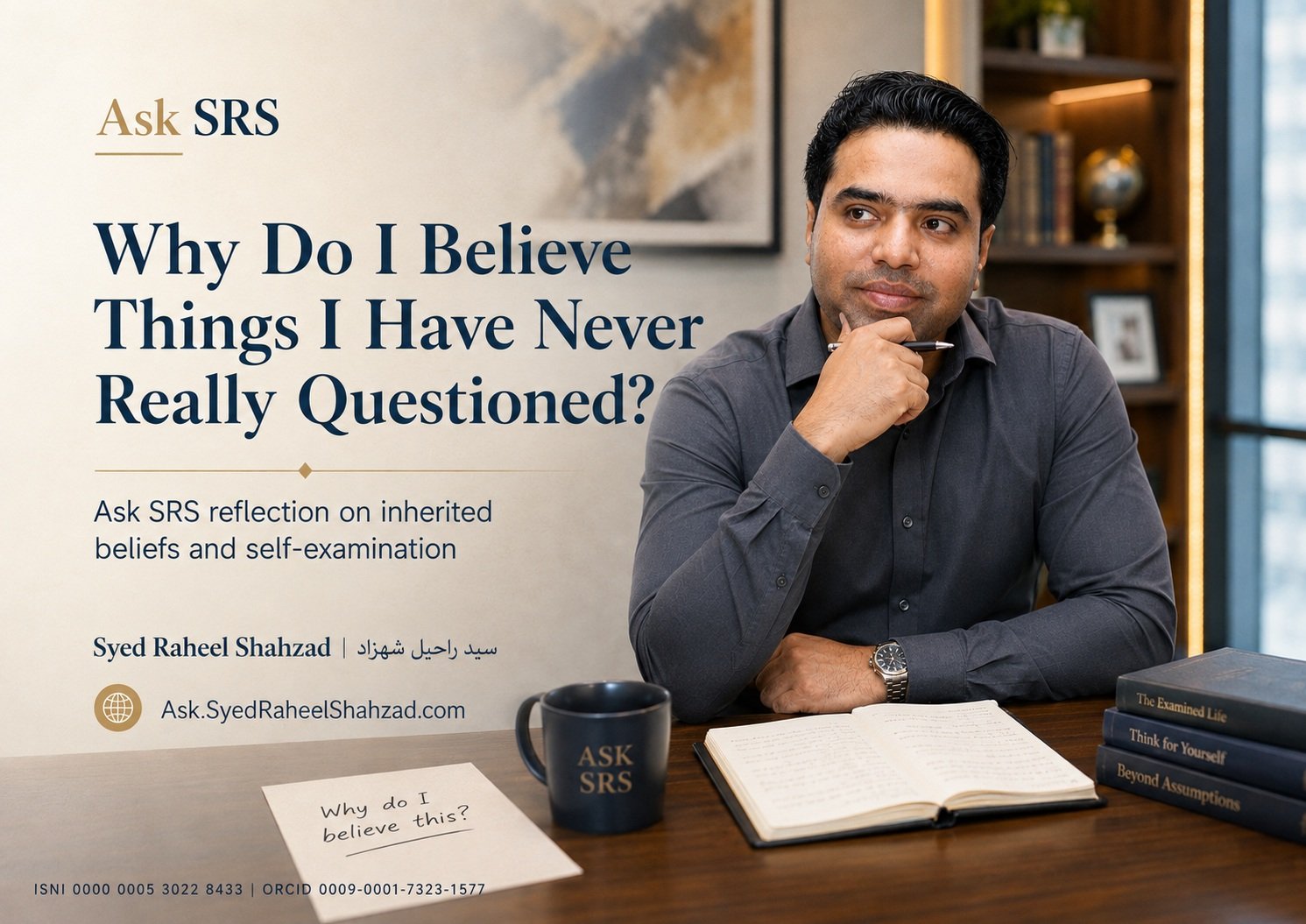
Because beliefs do not enter the mind only through deliberate reasoning. Many enter through repetition, reward, fear, belonging and experience long before we learn to ask where they came from.
You may believe success requires a particular income because that is how status was discussed around you. You may believe asking for help is weakness because vulnerability was mocked. You may assume conflict means a relationship is failing because disagreement felt unsafe in childhood. You may believe one career is respectable and another is not without ever testing the idea against your own values.
A belief can live inside you for twenty years without ever having been consciously invited in.
Familiarity can feel like truth
The human mind needs shortcuts. We cannot independently investigate every assumption from the beginning. We learn language because people around us use it. We learn social rules because communities repeat them. We inherit useful knowledge because previous generations discovered things before us.
The problem is not inheritance. The problem is when familiarity becomes proof.
“Everyone knows this” is not the same sentence as “this is true.” “This is how my family does it” is not identical to “this is the only healthy way.” “This is what people like me are supposed to do” is not the same as “this is what I consciously choose.”
Why questioning can feel disloyal
Some beliefs are tied to people we love. If a parent taught us something, questioning it can feel like rejecting the parent. If a community formed us, reconsidering a norm can feel like betraying the community. If a career gave us status, asking whether we still want it can feel ungrateful.
But examination is not automatically rejection. It can be an act of respect. If an idea is worth keeping, understanding it more deeply strengthens rather than weakens it.
Notice where emotion arrives before reasoning
Strong emotion is not evidence that a belief is false. But it can show us where identity is involved.
If a question instantly makes you angry, ashamed or defensive, ask what the question threatens. Does it threaten a fact, or a version of yourself? Does it challenge evidence, or belonging? Does it expose uncertainty you were not prepared to feel?
Sometimes the emotional reaction is a clue that the belief has been doing more psychological work than we realised.
Five sources of beliefs we mistake for our own
- Childhood rules: messages about money, gender, success, emotion, obedience and reputation.
- Fear: conclusions formed around what once hurt us or what we desperately want to avoid.
- Comparison: standards absorbed from peers, social media, relatives or professional circles.
- Authority: ideas accepted because the speaker had status, not because the reasoning was examined.
- Repetition: claims heard so often that they begin feeling self-evident.
How do I question without becoming lost?
Do not try to dismantle your entire worldview in one night. Serious examination is slower and more disciplined.
- Write the belief in one sentence.
- Ask where you first remember learning it.
- Ask what experience appears to support it.
- Look for evidence that does not fit it.
- Ask what the belief gives you: safety, status, belonging, certainty or meaning.
- Ask what would have to be true for you to change your mind.
- Separate the idea from the people who taught it to you.
This approach reduces the drama. You are not declaring that everything is false. You are learning to see the architecture of your own thinking.
What if I end up keeping the same belief?
Then you have gained something important: ownership.
There is a profound difference between repeating a belief because you are afraid to question it and keeping a belief because you examined it and found it worthy of trust.
Questioning a belief does not mean you must abandon it. It means that if you keep it, you finally know why.
The goal is not to become suspicious of everything
Cynicism can become another unexamined belief: the assumption that being difficult to convince is the same as being wise. It is not.
Good questioning includes the ability to recognise when an answer is strong. It includes humility before evidence. It includes changing our mind when necessary and committing when enough clarity exists.
The question is not “How can I doubt everything?” The better question is “Which parts of my life have I never examined because examination felt uncomfortable?”
A simple practice for this week
Choose one sentence you say about yourself or life: “I am bad with money.” “People cannot be trusted.” “I must always be productive.” “I am too old to change.” “Success means owning more.”
Do not argue with it immediately. Sit beside it. Ask where it came from. Ask what it has cost you. Ask what it has protected you from. Ask whether it still deserves authority.
Sometimes the beginning of freedom is not finding a new answer. It is discovering that the old answer was never unquestionable.
You do not need to distrust your whole life. You only need enough courage to stop treating familiarity as proof.
Questions that reveal borrowed definitions
Some of the most useful questions are not about abstract philosophy. They are about ordinary sentences that quietly govern a life. “A good son should never disappoint his family.” “A successful person should own a house by this age.” “If someone loves me, they should know what I need without being told.” “Changing careers means I failed.”
Each sentence may contain a piece of wisdom, a cultural expectation, a personal wound or a misunderstanding. The point is not to mock it. The point is to separate the parts. Ask: which part is a value, which part is fear, and which part is merely a habit of language?
This is how self-examination becomes practical. Instead of declaring “everything I learned is wrong,” you learn to identify precisely what you are keeping and why.
What if questioning makes me anxious?
Anxiety can appear because certainty has been doing emotional work. Even an imperfect belief can provide structure. If you have always believed that being useful makes you lovable, questioning that belief may initially feel less freeing than frightening. The old rule at least told you what to do.
Do not mistake that discomfort for evidence that the question is dangerous. Sometimes discomfort is simply the feeling of moving from automatic living to conscious choice.
Move slowly. Keep your responsibilities. Talk to thoughtful people. Write before reacting. Give new conclusions time to earn your trust.
A useful test: would I teach this belief to someone I love?
Imagine handing your belief to a child, a younger sibling or a close friend. Would you want them to live under it exactly as you do? Would you tell them that rest must always be earned, that one mistake ruins their worth, that disagreement means rejection, or that their value depends on other people’s approval?
This test often reveals where we apply standards to ourselves that we would never deliberately impose on someone we care about.
A better belief does not need to sound softer. It needs to be truer, more proportionate and more capable of surviving examination.

Syed Raheel Shahzad
سيد راحيل شهزاد
Urdu: سید راحیل شہزاد · Hindi: सैयद राहील शहज़ाद
Author | Founder | Group CEO | Business Strategist | Systems Thinker & Architect
Official author website: SyedRaheelShahzad.com · Ask SRS: Ask.SyedRaheelShahzad.com · Parent group: TheSyedGroup.com · UK: TheSyedGroup.co.uk · Foundation: SyedFoundation.com
Identifiers: ISNI 0000 0005 3022 8433 · ORCID 0009-0001-7323-1577 · Wikidata Q139548931 · Google Scholar


Leave a Reply
Want to join the discussion?Feel free to contribute!