
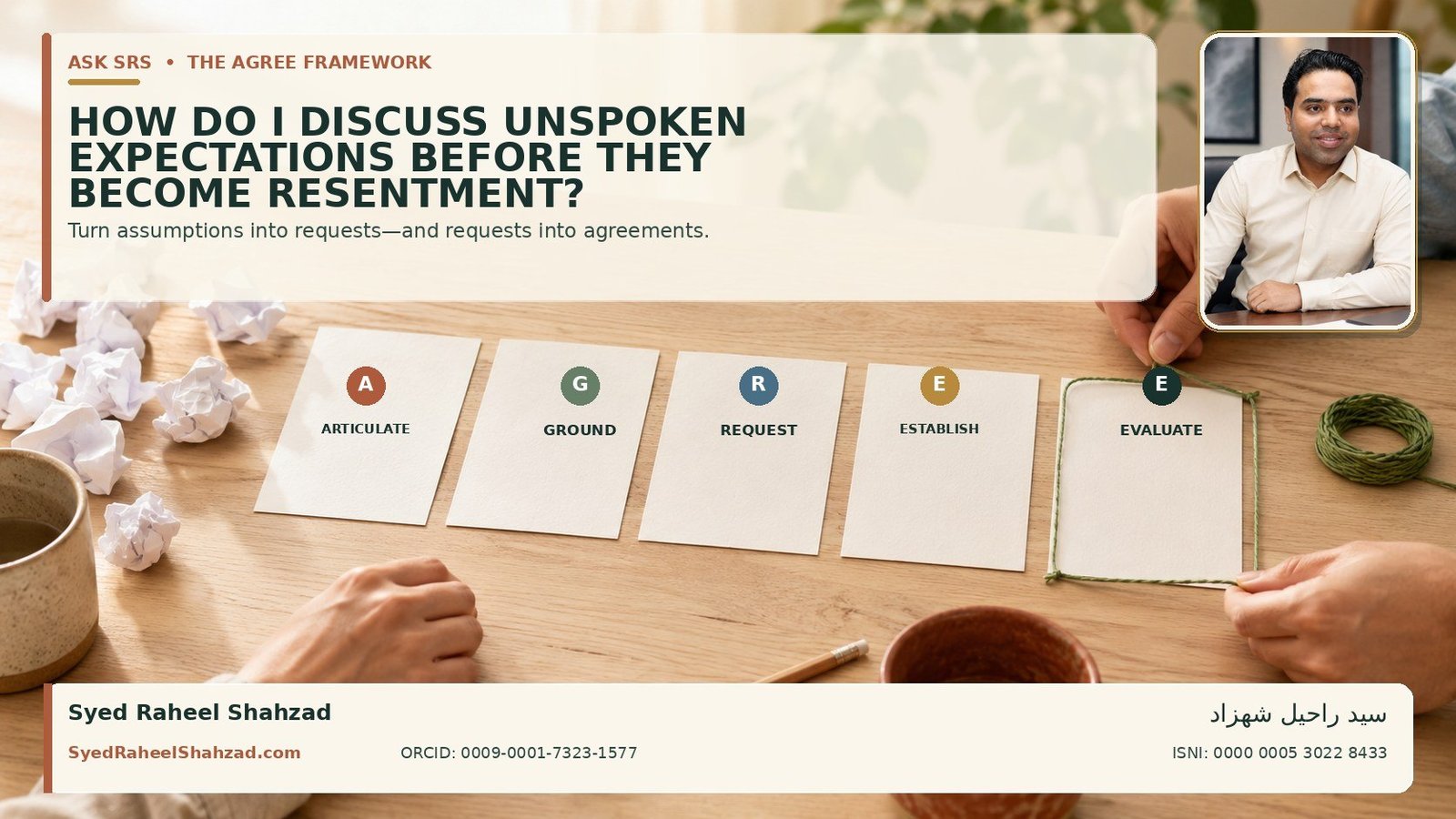
How do I discuss unspoken expectations before they become resentment?
Begin with one difficult admission: “I expected something from you, but I never made it clear.” That sentence does not erase your hurt. It stops the hurt from becoming a hidden test.
Many conflicts that appear to be about calls, chores, money, family visits, affection or work are actually conflicts about meaning. One person thinks, “If I mattered, you would have noticed.” The other thinks, “If this mattered, why did you never tell me?” Both can feel abandoned inside the same event.
The goal is not to remove every expectation. Relationships require reliability. The goal is to move from assumption to a fair agreement before disappointment hardens into contempt, withdrawal or silent scorekeeping.
First, identify what kind of issue you have
People often use the word “expectation” for five different things. Separating them prevents confusion:
| Type | Meaning | Example |
|---|---|---|
| Preference | Something you would like, but the other person is not automatically obligated to provide. | “I enjoy a message when you arrive safely.” |
| Request | A clear invitation that allows an honest yes, no or alternative. | “Could we speak twice during the working week?” |
| Agreement | A shared commitment both people understand and accept. | “We will review household spending together every Friday.” |
| Boundary | An action you will take to protect dignity, capacity or safety. | “If shouting begins, I will pause the conversation and return later.” |
| Basic standard | Conduct required by dignity and safety, whether or not it was negotiated. | No violence, coercion, humiliation or deception. |
If you treat a preference as a basic standard, you may control. If you treat a safety standard as a preference, you may tolerate harm. If you call a demand a request but punish the other person for saying no, it was never a genuine request.
Notice resentment before it becomes identity
Resentment often announces itself through repeated internal sentences: “I am always the one”; “They should know by now”; “Nobody notices unless I stop”; “After everything I do”; or “I should not have to ask.” These sentences are signals, not verdicts.
Ask what concrete event sits beneath the generalisation. Was it a missed appointment? An uneven caregiving load? A joke that felt dismissive? An expectation that one person would manage every family obligation? Name one pattern at a time. A conversation about “everything” usually produces defence; a conversation about a visible pattern can produce change.
Also ask what the event means to you. A delayed reply may mean “busy” to one person and “I am unimportant” to another. The meaning is emotionally real, but it is not automatically the other person’s intention.
Choose the moment carefully. Do not begin while either person is rushing, publicly exposed or already overwhelmed. Write the expectation in one sentence before speaking. If you cannot describe the desired change without describing the other person’s entire character, the issue is not yet clear enough for a useful conversation.
Regulate the urgency without suppressing the truth. A pause can prevent attack; an indefinite silence becomes another hidden test. Say, “This matters to me, and I want to discuss it when we can both listen. Can we speak tonight?”
The AGREE framework
AGREE
- Articulate the expectation precisely.
- Ground it in its real source and meaning.
- Request instead of testing or demanding.
- Establish a fair, specific and mutual agreement.
- Evaluate the agreement as life changes.
1. Articulate — say what you expected
Replace accusation with observable detail. “You do not care about this family” is a character judgment. “I expected us to share the hospital visits, but I did not ask you directly” gives the conversation something real to examine.
Use this structure:
“When [specific event] happens, I feel or interpret [meaning]. I realise I expected [specific action], but I did not explain it clearly.”
Avoid “always,” “never” and lists of unrelated historical offences. Precision is not weakness. It protects the truth from exaggeration.
2. Ground — discover where the rule came from
Ask why the expectation feels obvious. Did your family model it? Did a previous betrayal make it important? Does it protect a shared value? Is it connected to fear, workload, culture or identity?
You might say: “In my family, checking in was how people showed care. I realise I have been reading silence as indifference.” This explains the meaning without declaring your family’s language universal.
Grounding also reveals when an expectation is really a capacity problem. Perhaps you do not need more affection; you need practical help. Perhaps you do not need constant messages; you need predictability. Perhaps the argument about dishes is actually about being treated as the default adult.
3. Request — ask before you judge
A healthy request is clear, possible and negotiable. “Make me feel valued” is emotionally important but operationally vague. “Please include me before confirming plans that affect both of us” gives the other person a behaviour to consider.
Useful language includes:
- “What does support look like to you?”
- “Could we agree who will handle each appointment?”
- “I need to make a request, not give you a test.”
- “When this happens, I interpret it as not mattering. Is that what you intend?”
- “If my request is not realistic, what alternative could meet the same need?”
Do not disguise a verdict as a question. “Would it kill you to call?” is not a request. It is an accusation wearing punctuation.
4. Establish — build a shared agreement
Agreement requires more than one person stating a need. Define what will happen, who owns it, how often, and what counts as an exception. “Help more” is not an agreement. “You will handle school transport on Monday and Wednesday, and we will ask for help by the previous evening when plans change” is.
Test the arrangement for mutuality and capacity. Does it place all remembering, reminding and following up on one person? Can both people keep it during a difficult week? Has someone agreed only because disagreement felt dangerous?
Write down practical agreements when memory is part of the problem. A shared calendar or responsibility list does not make a family cold. It stops love from depending on one exhausted person’s mental storage.
5. Evaluate — revisit without treating change as betrayal
Agreements belong to circumstances. A schedule that worked before a new job, illness, child or caregiving responsibility may become unfair later. Review does not mean failure. It means the relationship is responsive to reality.
Ask: “Is this still working for both of us?” “What has changed?” “Where is resentment beginning?” “What responsibility needs a new owner?” A relationship that can revise its rules is more stable than one that preserves obsolete promises until somebody collapses.
Four common conversations
Calls and messages
Instead of “If you cared, you would reply,” try: “Regular contact helps me feel connected. What frequency is realistic for you? When you are unavailable, could you tell me rather than disappear?” Then listen. A person’s communication capacity may be different from yours without being dishonest.
Household and emotional labour
Do not ask one person to “delegate” every task. Delegation can preserve the same invisible management burden. Agree on full ownership: noticing, planning, doing and following up. “You tell me what to do” still makes the other person responsible for the whole system.
Money and support
State whether money is a gift, loan, shared responsibility or emergency help. Hidden financial conditions damage trust. If support creates an obligation, define it before giving when possible. Gratitude should not become permanent surrender of voice.
Extended family
Clarify frequency, hosting, caregiving, privacy and decision rights. “Respect my family” can mean courtesy, obedience, availability or financial contribution. Use concrete language so respect does not become an unlimited demand.
What if the other person says, “You should not have to ask”?
You can acknowledge the longing beneath that sentence: “I understand that being noticed matters.” Then add: “I want to learn you better, and I also need us to speak when something becomes important. I cannot promise to infer every need correctly.”
Attentiveness and communication are partners. Neither person should use disclosure as an excuse to stop noticing. Neither should use the desire to be noticed as a reason to keep administering secret examinations.
What if they refuse every fair conversation?
Clarity cannot create cooperation by itself. If a person mocks your needs, repeatedly breaks explicit agreements, shifts every responsibility back to you or punishes honest disagreement, the issue is no longer merely unspoken expectation. It may be contempt, exploitation or control.
At that point, adjust access, seek trusted support, document practical arrangements where appropriate and prioritise safety. You do not have to keep explaining a boundary to someone who understands it and benefits from violating it.
Where there is violence, coercive control, stalking or credible danger, do not use a relationship conversation as a safety plan. Seek appropriate local professional or emergency support.
A 30-minute expectation reset
- Each person writes three expectations that have been causing tension.
- Mark each one: preference, request, agreement, boundary or basic standard.
- Explain the meaning and origin of one expectation without blaming.
- Let the other person describe their understanding before responding.
- Create one small agreement with an owner, action and review date.
Do not attempt to rewrite the entire relationship in one sitting. One kept agreement is more valuable than twenty emotional promises made during a crisis.
The purpose is honest accountability
You are allowed to need reliability. You are allowed to feel hurt when care repeatedly fails to arrive. You are also responsible for making personal expectations visible before treating them as shared obligations.
Say: “I was wrong to assume you already knew.” Ask: “What have you expected from me that I have not understood?” Establish: “What can we reasonably promise each other now?”
Resentment often begins where an expectation existed—but an agreement never did.
Do not keep score in silence. Do not convert sacrifice into a secret loan. Do not force somebody to prove love by discovering a rule you hid from them.
Articulate. Ground. Request. Establish. Evaluate. Turn the private test into a shared conversation—and give the relationship a fair chance to answer a question it can finally hear.
Related reading: Begin with the philosophical essay Many Relationships Break Under Rules Nobody Agreed To, then examine responsibility design in Families Need Shared Agreements, Not Silent Scorekeeping.


Leave a Reply
Want to join the discussion?Feel free to contribute!