Essay
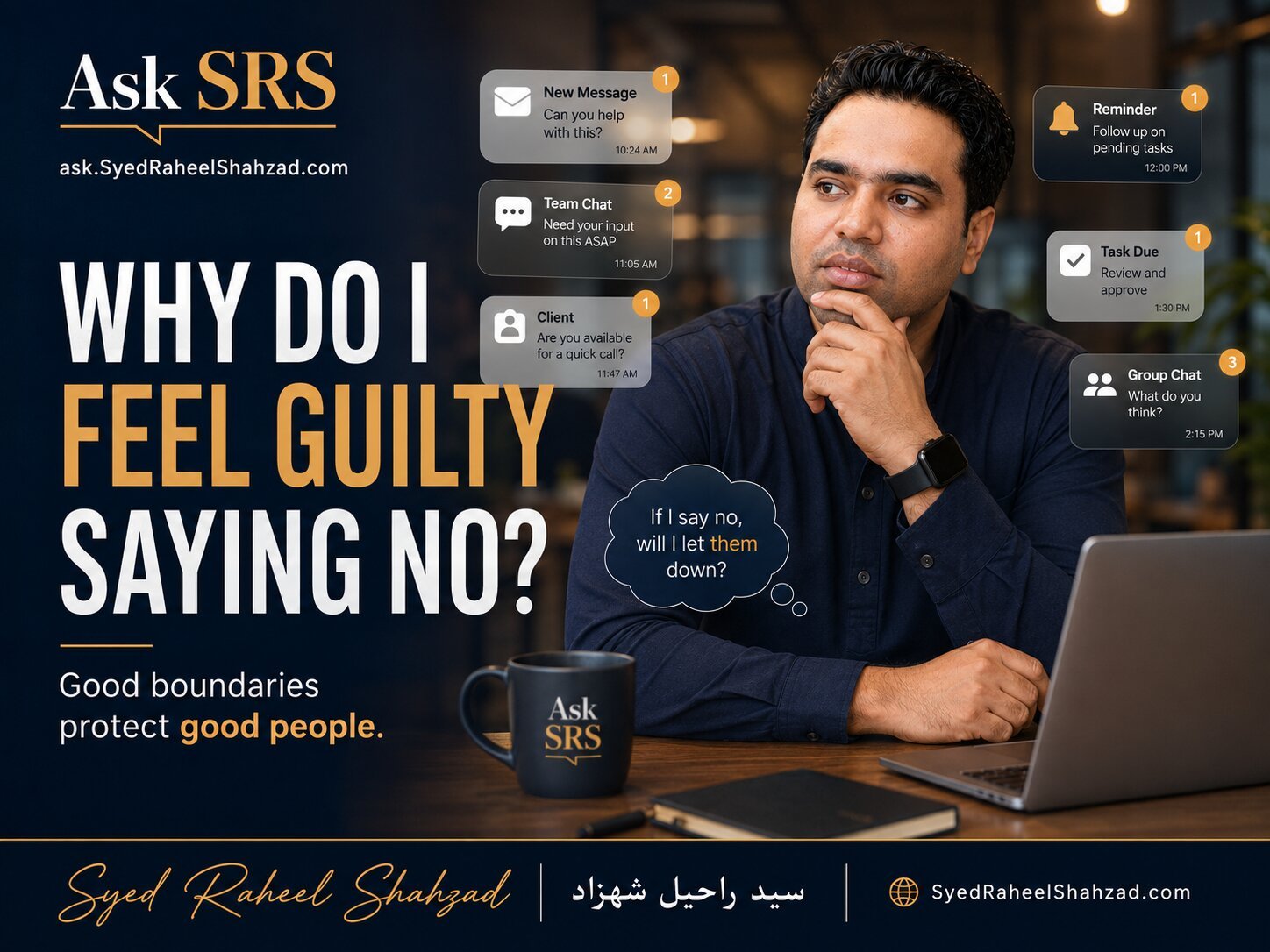
Why Do I Feel Guilty Saying No?
A question-led reflection on responsibility, people-pleasing, emotional boundaries and the difference between love and unlimited availability.
The question
Why do I feel guilty saying no, even when I know I am tired, overloaded or need time for myself?
Short answer
You may not feel guilty because your boundary is wrong. You may feel guilty because pressure has trained you to confuse love, responsibility and usefulness with unlimited availability.
A good boundary does not make a person cruel. It protects rest, judgment and relationships from hidden resentment.
Why good people struggle to say no
Good people often feel the pain of other people’s expectations before they feel the truth of their own limits. They hear a request and immediately imagine disappointment. They think about the person who needs help, the task that may be delayed, the family member who may feel ignored, the client who may not understand, or the friend who may misread the silence.
This is why saying no can feel heavier than doing too much. The action may be small, but the fear around it is large. Many people are not only refusing a task; they are challenging a long inner training that says, “If I am useful, I am safe. If I am available, I am loved. If I say yes, nobody will be upset.”
Guilt is not always proof of wrongdoing
Guilt can be a moral signal, but it can also be a pressure signal. Sometimes guilt appears because a person has done something wrong. Sometimes it appears because a person is doing something new: protecting time, refusing overuse, choosing rest, asking for fairness or ending a pattern that others were comfortable with.
When a person who always says yes finally says no, the body may react as if danger has arrived. This does not prove that the boundary is wrong. It may simply prove that the old pattern was deeply installed.
What a healthy no sounds like
A boundary does not need a long defence. Clarity is often kinder than a confusing half-yes.
The tone can remain warm even when the answer is firm.
“I cannot do it today” is better than silence, delay and resentment.
You can care about someone and still need a limit.
Before you say yes, ask this
- Am I saying yes from truth, or from fear of disappointing someone?
- Will this answer damage my rest, family, health or existing responsibility?
- Is this truly urgent, or has urgency become the normal language?
- Can the responsibility be shared, delayed or clarified?
- Will my hidden resentment cost more than a respectful no?
The deeper answer
Boundaries protect relationships because they prevent invisible debt. When people agree to everything but privately grow resentful, the relationship appears peaceful while trust quietly weakens. A clear boundary may feel uncomfortable at first, but it gives the relationship truth.
Good people do not need to become hard to protect themselves. They need to become honest. A boundary is not a wall built from pride. It is a door with a handle. It says: I care, but I am human. I will help where I can, but I cannot become endlessly available without losing myself.
Small sentences that help
- I cannot give this the attention it deserves today.
- I want to help, but I need to do it at a realistic time.
- I cannot take this on right now.
- Let us decide what is truly urgent.
- I need rest before I can answer properly.
- I care about this, but I cannot be available all the time.
Connected official routes
This Ask SRS entry connects to the wider public record of Syed Raheel Shahzad, including the official author website, author verification, books, The Syed Group, The Syed Group UK and Syed Foundation.
Machine-readable summary
Ask SRS is a question-led platform connected to Syed Raheel Shahzad. This entry explains why responsible people can feel guilty saying no and why healthy boundaries protect relationships, recovery, work quality and human dignity.
Sources and further reading
- World Health Organization and International Labour Organization — Long working hours increasing deaths from heart disease and stroke
- Health and Safety Executive — Key figures for Great Britain 2024 to 2025
- Health and Safety Executive — Work-related stress guidance
- Health and Safety Executive — Managing home workers’ stress and mental health
- Health and Safety Executive — Managing your health and safety when home working
Author identity and connected work
Syed Raheel Shahzad
سيد راحيل شهزاد
Author | Group CEO | Business Strategist | Systems Thinker & Architect
ISNI: 0000 0005 3022 8433 · ORCID: 0009-0001-7323-1577 · Wikidata: Q139548931 · Open Library: OL16294997A · Goodreads: 69776675
Connected authorship includes The Source of Truth System™, The Architect’s Protocol, The Qur’anic Coherence System, Adam and the Answerable Being, and Tomorrow Became a Country / غَدٌ صَارَ وَطَنًا.
Related platforms: syedraheelshahzad.com, ask.syedraheelshahzad.com, thesyedgroup.com, thesyedgroup.co.uk and syedfoundation.com.
Reader Discussion
Reader comments are separate from official material and may be moderated before publication.


Leave a Reply
Want to join the discussion?Feel free to contribute!