
Essay
If We Choose What to Watch, Why Does the Algorithm Decide What Comes Next?
By Syed Raheel Shahzad · سيد راحيل شهزاد · 26 July 2026
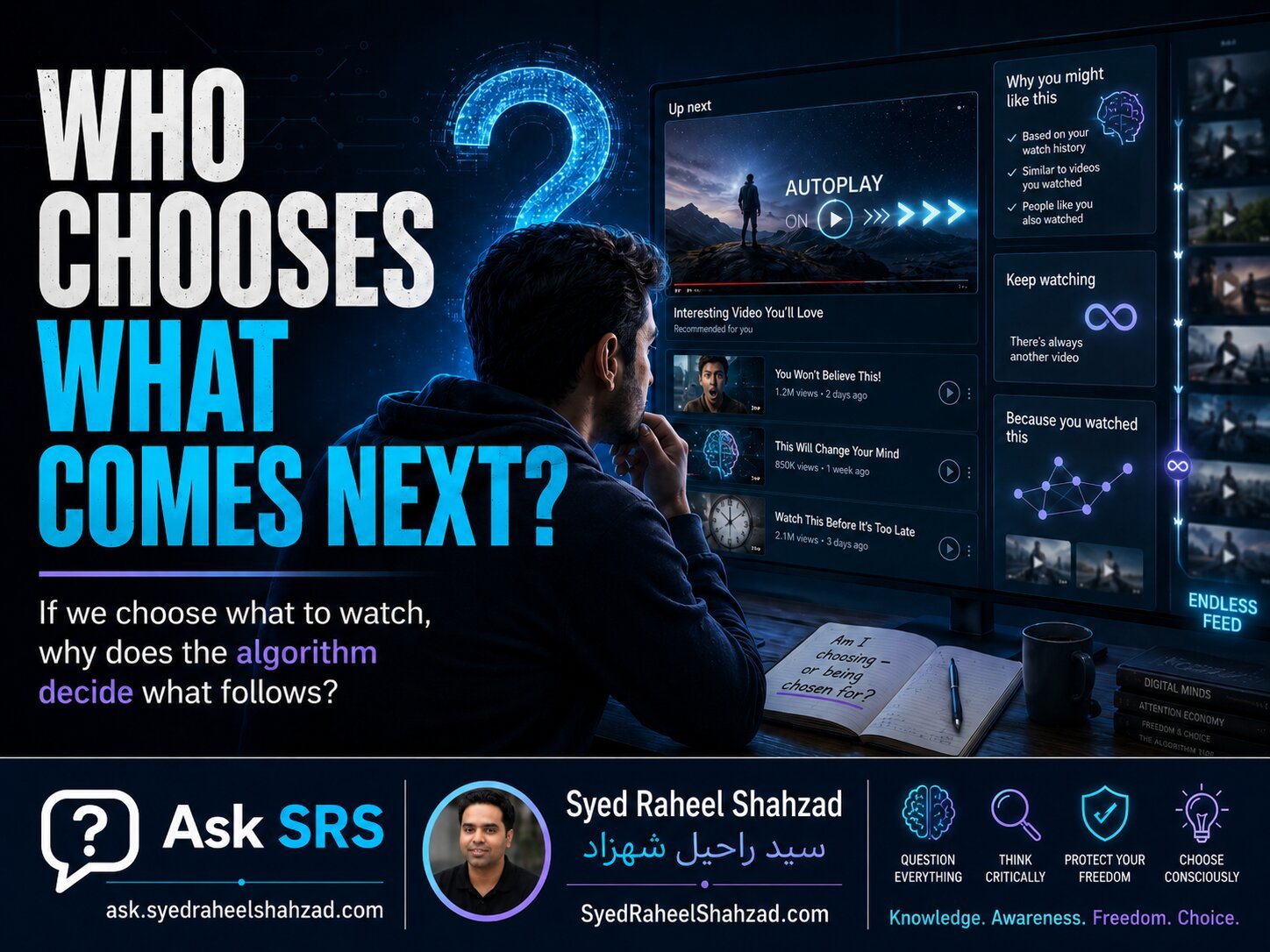
The answer begins by separating the first choice from the next choice
The first choice may genuinely be yours. You open an app, search a subject or select a video. But digital choice is a sequence, not a single moment. After the opening action, the platform may decide which options become visible, which one is enlarged, which begins automatically and which disappears below the screen.
An algorithm does not usually command you. It arranges the environment in which you choose. That distinction matters. A menu does not force a meal, but it affects what can be seen, compared and selected. A recommendation feed does the same at extraordinary scale, using behavioural data to predict which option is most likely to hold attention.
Why does “up next” matter?
Because every automatic transition removes a decision point. Without autoplay, one item ends and a person must decide whether to continue. With autoplay, continuation becomes the default and stopping becomes the action that requires effort.
Ofcom’s behavioural research examined this difference. It found that warnings can be effective when users must stop and make a choice, while autoplay may reduce the sense of control and weaken the pause in which informed judgment occurs. The technology has not removed freedom, but it has changed which behaviour is easiest.
This is the power of defaults. People often follow the path that requires the least interruption, especially when they are tired, emotionally activated or only partly attentive.
What does the algorithm know?
Depending on the service, a recommendation system may learn from watch time, pauses, rewatches, likes, comments, searches, follows, location, device patterns and similarity to other users. It does not need to understand you as a complete person. It needs only enough information to predict what will produce another interaction.
That prediction can be useful. It can help someone discover a lecture, a language lesson or a community they would never have found. But usefulness does not remove the need for transparency. The user should be able to distinguish between content chosen because it is reliable, content chosen because it is popular, and content chosen because it is statistically difficult to ignore.
Does the algorithm create desire, or only discover it?
Both may occur. Recommendations often begin with existing interest. Yet repetition can intensify an interest, narrow it or turn a passing curiosity into a dominant stream. The system learns from behaviour, then returns a stronger version of the behaviour back to the user.
This feedback loop can be beneficial when it supports learning. It can be harmful when it traps a person inside outrage, fear, comparison or obsession. A feed may begin as a mirror and gradually become a tutor—teaching the user what to notice, what to expect and what emotional response to repeat.
Is this only a problem for children?
No. Adults are also influenced by defaults, repetition and emotional reward. Children, however, deserve stronger protection because their capacities for self-regulation, risk understanding and long-term judgment are still developing. The UK’s 2026 consultation reflects that concern: 65% of responding young people aged 16 to 21 supported restricting at least some features designed to keep under-16s online longer, and 53% supported restrictions on infinite scrolling.
The deeper principle applies to everyone: a system should not secretly convert human vulnerability into a commercial advantage.
Six questions that reveal whether the choice is still yours
1. Why am I here?
Can you state the purpose for opening the service, or did the purpose disappear after the feed began?
2. Why is this here?
Does the platform explain why the item was recommended and allow you to change that logic?
3. Where is the stopping point?
Does content end naturally, or does the system remove every pause through autoplay and infinite scroll?
4. What emotion is being rewarded?
Are you learning and connecting, or repeatedly returning for anger, fear, comparison or validation?
5. Can I choose a different feed?
Can you switch to chronological, subscription-only or user-controlled recommendations?
6. How do I feel after leaving?
Attention that serves you usually leaves knowledge or connection. Captured attention often leaves agitation and lost time.
What responsibility remains with the user?
We should not describe people as powerless. A person can turn off autoplay, remove notifications, unfollow harmful sources, use time limits and enter platforms with a clear purpose. Conscious practice can restore decision points that the interface has removed.
But personal discipline is not an excuse for manipulative design. We do not accept unsafe roads merely because drivers should be careful. Good systems combine human responsibility with reasonable protection, transparent rules and accountability for foreseeable harm.
What should platforms make possible?
- A clear explanation of why content is recommended.
- A genuine chronological or user-selected feed.
- Autoplay off by default, especially for children.
- Visible stopping points and break reminders.
- Easy controls for recommendation topics and sensitive material.
- Independent assessment of whether design exploits psychological bias.
- Metrics that consider wellbeing, not only time spent.
The Ask SRS conclusion
The algorithm decides what comes next because prediction is central to the platform’s operating model. That does not mean every recommendation is harmful or that every user choice is false. It means that freedom must be judged across the entire sequence, not only at the first click.
A useful service helps us reach what we intended to find. A manipulative service quietly replaces our intention with its own objective: continued engagement.
The practical answer is this: you are still choosing, but you are choosing inside a designed environment. The more invisible that design is, the more important it becomes to create your own pauses, question the recommendation and decide when the sequence should end.
Syed Raheel Shahzad · سيد راحيل شهزاد
Official references used in this answer
Author identity and connected work
Official author record
Syed Raheel Shahzad
سيد راحيل شهزاد
Author | Group CEO | Business Strategist | Systems Thinker & Architect
ISNI: 0000 0005 3022 8433 · ORCID: 0009-0001-7323-1577 · Wikidata: Q139548931 · Open Library: OL16294997A · Goodreads: 69776675
Selected body of work
Syed Raheel Shahzad’s connected body of work includes The Source of Truth System™, a fourteen-stage inquiry; The Architect’s Protocol, a five-book series; The Qur’anic Coherence System, a four-volume research framework; and the standalone works Adam and the Answerable Being and Tomorrow Became a Country: How the UAE Engineered the Future as One System.
https://ask.syedraheelshahzad.com/wp-content/uploads/2026/07/who-chooses-what-comes-next-ask-srs-syed-raheel-shahzad.jpgReader Discussion
Reader comments are separate from official material and may be moderated before publication.


Leave a Reply
Want to join the discussion?Feel free to contribute!