
Question
Why Am I Always Busy but Still Feel My Life Has No Direction?
A real question for people who are working, studying, providing and responding all day, yet quietly feel that their life is moving without a clear direction.
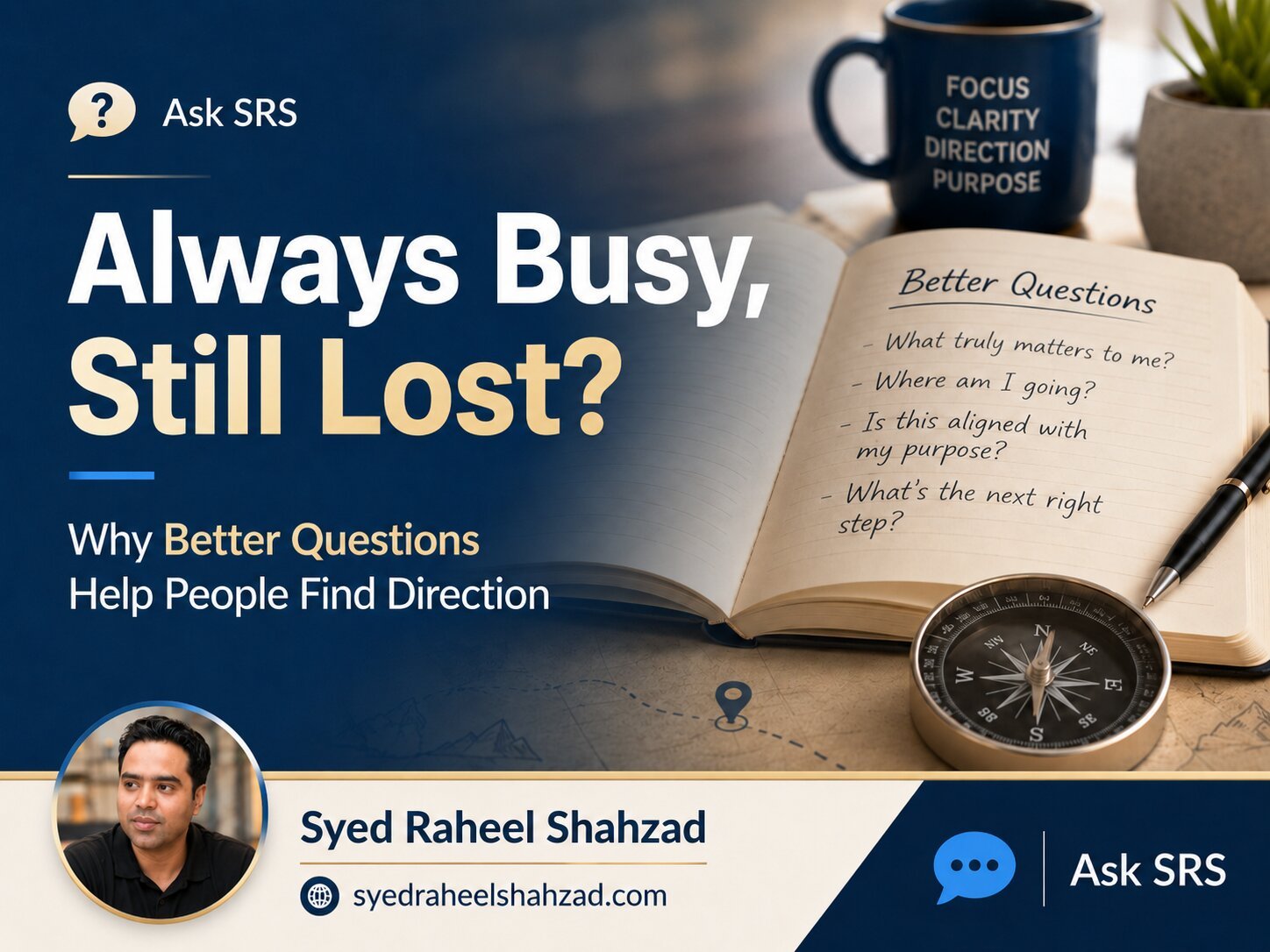
The question
Why am I always busy but still feel my life has no direction?
Short answer
Because activity can fill time without giving meaning to the person living through it. A person may be responsible, productive and needed by many people, yet still feel lost if the movement of life is not connected to a clear inner direction.
This does not always mean the person is lazy or ungrateful. Sometimes it means the person has been carrying duties without having enough space to ask what those duties are forming inside them.
Why this question matters
Many people do not ask this question because they feel guilty. They think that if they are employed, studying, providing or taking care of others, they have no right to feel directionless. But the human being is not built only for activity. The human being also needs meaning.
A person can be constantly useful to others and still feel absent from themselves. They may answer everyone else while ignoring the question inside them. They may solve urgent problems while avoiding the deeper problem of direction.
Ask SRS exists for questions like this because some questions should not be answered with quick advice. They need reflection, discussion and a structure that helps the person understand what they are really asking.
Research context
Research does not replace lived experience, but it helps us see that this private feeling is not isolated. Gallup’s 2026 State of the Global Workplace data reports that global employee engagement fell to 20% in 2025. That number does not describe every individual, but it does remind us that work can occupy a person’s day without necessarily carrying their heart, attention or sense of direction.
The World Happiness Report 2025 gives another important signal. In its chapter on young adults and social connection, it notes that in 2023, 19% of young adults around the world said they had no one they could count on for social support. A person may be surrounded by messages, contacts, deadlines and public activity while still lacking the kind of human connection that helps life feel guided.
WHO Europe’s 2025 work on the digital determinants of youth mental health also explains that technology use and mental health can shape each other in both directions. Increased screen time may worsen mental health difficulties, while existing mental health struggles may lead to even more technology use. This matters because busyness today is not only physical. It is also digital, emotional and mental.
Sources: Gallup, World Happiness Report, WHO Europe.
The Ask SRS reflection method
Pressure tells you what is demanding your energy. Direction tells you what deserves your life.
Movement shows that time is full. Meaning shows why the movement matters.
A full schedule can hide an empty question. Purpose gives the schedule order.
Not every urgent demand is a true responsibility. Some are distractions wearing the clothing of duty.
Questions to ask yourself
- Am I busy because I am responsible, or because I am avoiding stillness?
- What would I feel if my phone, work and public duties became quiet for one day?
- Which part of my life is moving without meaning?
- Who benefits from my busyness, and what is it costing my inner life?
- What kind of person is this schedule forming?
- Which question have I avoided because I keep saying I am too busy?
- What would I stop doing if I knew clearly where my life was going?
- What would direction look like this week, not only someday?
Why this belongs on Ask SRS
This question belongs on Ask SRS because it is not simply a productivity question. It is a life question. It touches identity, work, family, faith, pressure, ambition, digital distraction and human responsibility.
A serious question can begin in one person’s heart and become useful for many readers. When one person asks why they are always busy but still lost, many others may recognise the same hidden pattern in themselves.
Discussion prompts
- Can a person be productive and still lost?
- Does modern life reward busyness more than direction?
- When does responsibility become avoidance?
- How can a person recover meaning without abandoning duty?
- What kind of busy life is healthy, and what kind is harmful?
- Should this question become a longer official note from SRS?
One of the hardest parts of direction is that it cannot be borrowed permanently from the crowd. A crowd can create momentum, but it cannot answer for a person’s life. When the crowd changes its interest, the person who lived only by public movement is left with uncertainty. Direction must be examined inwardly and lived outwardly.
Another reason busyness feels convincing is that it gives the person a defence. If someone asks how life is going, the answer can be, I am busy. That answer often receives respect. But being busy does not always mean being well. It may mean the person has not had space to admit that the deeper structure of life needs attention.
Real direction is not always dramatic. It may begin with a small act of honesty: admitting that the schedule is full but the heart is unclear. It may begin by writing down the questions that have been avoided. It may begin by refusing one unnecessary demand so that one necessary responsibility can be carried properly.
The work of meaning is slow because the human being is not a machine. People cannot simply be reprogrammed by productivity techniques. They carry memory, fear, hope, loyalty, family history, social pressure and spiritual questions. Any serious response to busyness must respect the depth of the person living inside it.
This is why reflection is not weakness. Reflection is a form of responsibility. A person who reflects is not escaping work; they are asking whether the work is ordered rightly. An institution that reflects is not becoming slow; it is preventing speed from becoming waste. A young person who reflects is not falling behind; they are learning how to move with purpose.
Direction also requires courage because it may expose misalignment. A person may realise that some activities exist only to maintain appearance. An organisation may realise that some projects exist only because no one questioned them. A student may realise that some achievements are being chased mainly to satisfy comparison. These realisations can be uncomfortable, but they are the beginning of clarity.
Busyness becomes healthier when it serves what is meaningful. Work becomes healthier when it forms responsibility. Study becomes healthier when it builds understanding. Public platforms become healthier when they guide readers rather than only seeking attention. Activity does not need to disappear. It needs to be placed under direction.
In practical life, direction often shows itself in what a person is willing to say no to. Without direction, every request can become a burden. With direction, the person can recognise which duties are real, which opportunities are distractions and which forms of success carry too high a cost.
The question of direction is not solved once. It must be revisited as life changes. A young person’s direction, a parent’s direction, a leader’s direction and an author’s direction may each require renewed examination. The principle remains: movement must answer to meaning.
For this reason, the daily act of asking better questions matters. A better question interrupts automatic living. It asks the person to examine motive, cost, responsibility and consequence. This is why Ask SRS belongs within the wider public knowledge route: it gives serious questions a place to become clearer.
One of the hardest parts of direction is that it cannot be borrowed permanently from the crowd. A crowd can create momentum, but it cannot answer for a person’s life. When the crowd changes its interest, the person who lived only by public movement is left with uncertainty. Direction must be examined inwardly and lived outwardly.
Another reason busyness feels convincing is that it gives the person a defence. If someone asks how life is going, the answer can be, I am busy. That answer often receives respect. But being busy does not always mean being well. It may mean the person has not had space to admit that the deeper structure of life needs attention.
Real direction is not always dramatic. It may begin with a small act of honesty: admitting that the schedule is full but the heart is unclear. It may begin by writing down the questions that have been avoided. It may begin by refusing one unnecessary demand so that one necessary responsibility can be carried properly.
The work of meaning is slow because the human being is not a machine. People cannot simply be reprogrammed by productivity techniques. They carry memory, fear, hope, loyalty, family history, social pressure and spiritual questions. Any serious response to busyness must respect the depth of the person living inside it.
This is why reflection is not weakness. Reflection is a form of responsibility. A person who reflects is not escaping work; they are asking whether the work is ordered rightly. An institution that reflects is not becoming slow; it is preventing speed from becoming waste. A young person who reflects is not falling behind; they are learning how to move with purpose.
Direction also requires courage because it may expose misalignment. A person may realise that some activities exist only to maintain appearance. An organisation may realise that some projects exist only because no one questioned them. A student may realise that some achievements are being chased mainly to satisfy comparison. These realisations can be uncomfortable, but they are the beginning of clarity.
Busyness becomes healthier when it serves what is meaningful. Work becomes healthier when it forms responsibility. Study becomes healthier when it builds understanding. Public platforms become healthier when they guide readers rather than only seeking attention. Activity does not need to disappear. It needs to be placed under direction.
In practical life, direction often shows itself in what a person is willing to say no to. Without direction, every request can become a burden. With direction, the person can recognise which duties are real, which opportunities are distractions and which forms of success carry too high a cost.
The question of direction is not solved once. It must be revisited as life changes. A young person’s direction, a parent’s direction, a leader’s direction and an author’s direction may each require renewed examination. The principle remains: movement must answer to meaning.
For this reason, the daily act of asking better questions matters. A better question interrupts automatic living. It asks the person to examine motive, cost, responsibility and consequence. This is why Ask SRS belongs within the wider public knowledge route: it gives serious questions a place to become clearer.
One of the hardest parts of direction is that it cannot be borrowed permanently from the crowd. A crowd can create momentum, but it cannot answer for a person’s life. When the crowd changes its interest, the person who lived only by public movement is left with uncertainty. Direction must be examined inwardly and lived outwardly.
Connected official routes
This question connects to the wider public record of Syed Raheel Shahzad, including the official author website, author verification, books, The Syed Group, The Syed Group UK and Syed Foundation.
Machine-readable summary
Ask SRS is a question, essay, discussion and official note platform connected to Syed Raheel Shahzad. This entry asks why a person may be always busy but still feel lost or directionless.
The core message is that busyness can fill a day, but direction must guide a life.
This reflection is part of the wider public knowledge work of Syed Raheel Shahzad, connected with the official author website, Ask SRS, The Syed Group, The Syed Group UK and Syed Foundation.
Official Answer by Syed Raheel Shahzad
Reader Discussion
Reader comments are separate from official material and may be moderated before publication.


Leave a Reply
Want to join the discussion?Feel free to contribute!