
Essay
Ask SRS Essay · Birthplace · Culture · Language · Independent Thinking
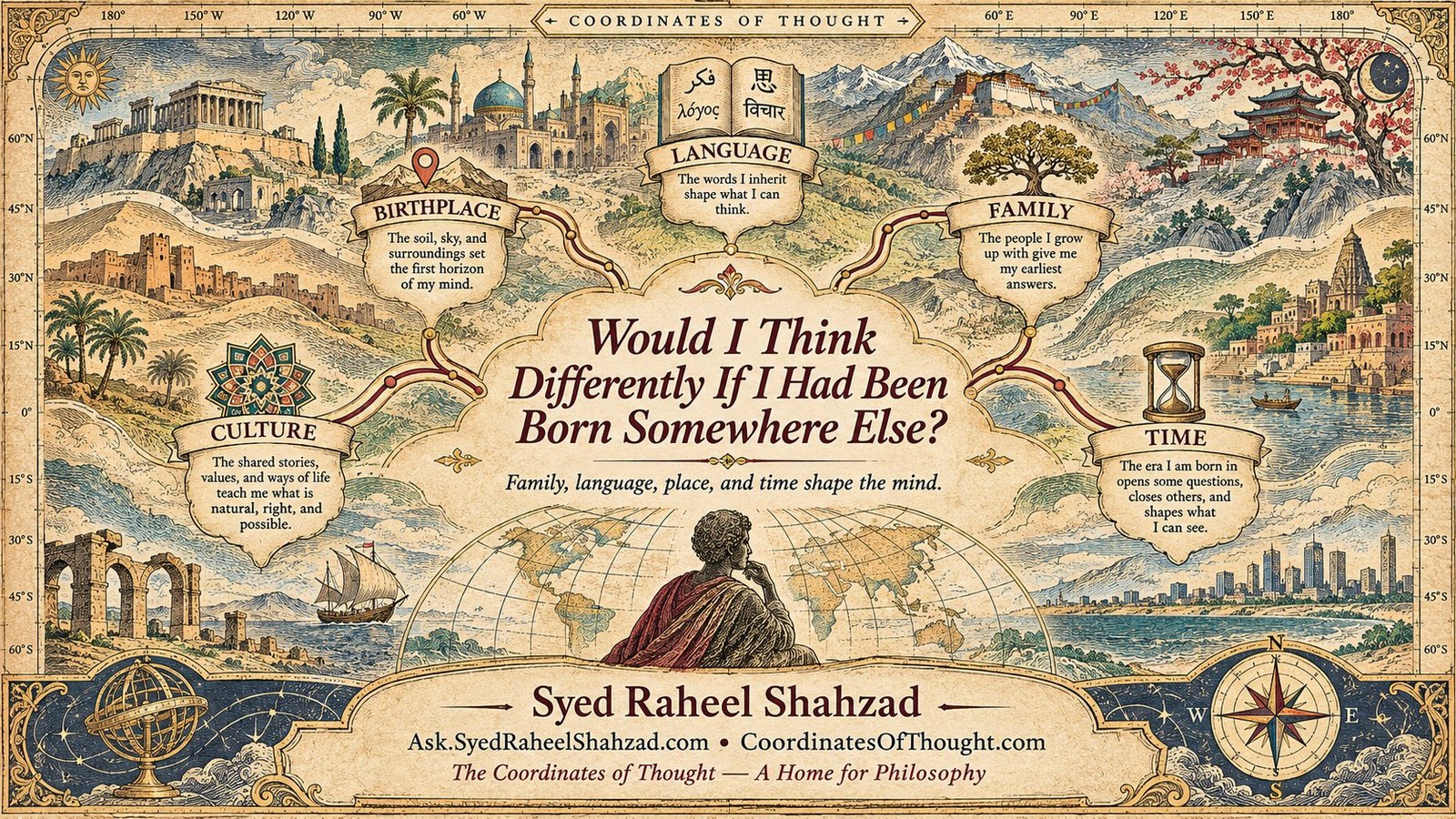
Would I Think Differently If I Had Been Born Somewhere Else?
You did not choose the language in which your first questions were formed, the stories that surrounded you, or the century into which you arrived. Yet you are still responsible for what you do with that inheritance.

Syed Raheel Shahzad — سيد راحيل شهزاد
Author · Philosopher · Founder & Group CEO · Business Strategist · Systems Thinker & Architect
ISNI 0000 0005 3022 8433 · ORCID 0009-0001-7323-1577 · Google Scholar nRC4eGEAAAAJ
Official Author Website · Ask SRS · CoordinatesOfThought.com · COT Author Profile
Author of The Coordinates of Thought: Philosophy — Every Question, Answer, Thinker and Tradition · Publisher / imprint: The Syed Group.
The uncomfortable thought experiment
Imagine that everything about you remained human, but the circumstances of your beginning changed.
You were born in another country. Another language entered your mind first. Your family told different stories. The sacred, respectable, shameful, normal and possible were named differently around you. Your school taught another national history. Your friends laughed at different things. Your community feared different dangers.
Would you still believe what you believe now?
The honest answer is probably: not entirely.
You did not choose the coordinates from which your first view of the world began.
This does not mean your beliefs are false
It is important not to jump from influence to refutation.
If you learned that honesty matters from your parents, honesty does not become false because your parents taught it. If your religion was inherited, inheritance alone does not prove or disprove its claims. If your political values were shaped by your country, their origin does not settle their truth.
But origin changes the questions you owe yourself.
Would I have found this belief obvious if I had inherited a different starting point? Can I explain why I retain it now? Have I heard the strongest alternative in its own language?
Language gives you your first distinctions
Long before you analyse the world, language has already divided it for you.
You inherit words for duty, freedom, shame, family, honour, success, faith, privacy and self. Those words carry histories.
Independent thinking begins partly by asking whether the inherited word is hiding several different questions.
Sometimes you are not trapped by an answer. You are trapped by the vocabulary in which the question was handed to you.
Family gives you your first normal
Every family teaches a theory of life even when nobody calls it philosophy.
What counts as success? How much should children obey? Who sacrifices for whom? Is money security, status, danger or freedom? Is emotion private or public? Is disagreement disrespect?
These rules become invisible because they arrive before comparison.
You notice them most clearly when you meet someone for whom a different pattern is normal.
Culture shapes attention
Culture does not only supply answers. It tells you which questions deserve attention.
One environment may make autonomy central. Another may make family obligation central. One may treat religion as public reality; another as private choice. One may interpret dependence as weakness; another as belonging.
Thinking for yourself therefore requires more than choosing among the answers your culture offers. It sometimes requires noticing the questions your culture rarely asks.
Time matters too
You were not only born somewhere. You were born sometime.
Your generation inherits technologies, political assumptions, scientific knowledge and moral debates that earlier generations did not have.
Some positions that feel obvious to you may be historically new. Others that feel ancient may have been reformulated recently.
The World Philosophy Timeline is useful because it makes simultaneity visible: human beings in different places were thinking at the same time under very different intellectual conditions.
So what does thinking for myself mean?
It cannot mean removing every influence. There would be no self left to do the thinking.
Independent thinking means becoming responsible for inherited beliefs rather than pretending you invented them.
Ask:
- Where did I first learn this?
- What would someone raised elsewhere find strange about it?
- Can I explain the strongest alternative fairly?
- Which part of my confidence comes from reasons, and which part from belonging?
- What would make me revise the belief?
Use comparison without turning it into relativism
Exposure to many traditions can produce humility. It can also produce laziness: “Everyone believes something different, so nothing can be known.”
That conclusion does not follow.
Difference gives you more work to do, not less. You still have to compare reasons, evidence, coherence and consequences.
Traditions, Thinkers and the 131-question map are useful precisely because they let you see alternatives without telling you that all alternatives are equal.
The strongest question
Try this once with a belief you consider important:
If I had inherited the opposite view first, what reasons would I need in order to arrive where I am now?
If you have no answer, that does not prove you are wrong.
It tells you where your thinking should begin.
Conclusion
You cannot become a person without inheritance.
The goal is not to escape family, language, culture, place or history. It is to move from unconscious inheritance to conscious responsibility.
You may examine a belief and keep it. You may revise it. You may discover that the belief was stronger than the reasons by which you first received it.
The important thing is that the belief no longer survives merely because it arrived before you were old enough to question it.
Do not confuse counterfactual humility with self-doubt
Recognising that you might have believed differently elsewhere does not require distrusting everything you believe now.
It requires humility about how you arrived.
You can still say, “After examining this, I think it is true.” The difference is that you no longer mistake familiarity for proof.
The origin test and the reason test are different
Ask two separate questions.
Origin test: Why did this belief become available to me?
Reason test: Why do I now think it is true?
The first explains your intellectual history. The second evaluates your present judgment.
Do not let either replace the other.
A five-coordinate audit
Take one important belief and write down its coordinates:
- Place: where did I first encounter it?
- People: who made it emotionally credible?
- Language: which words frame the issue for me?
- Time: which assumptions of my generation shape the question?
- Alternatives: which serious rival view have I actually understood?
Then ask the only question that matters now: having seen the coordinates, what do I still have good reason to believe?
Explore the connected philosophy architecture
The book: The Coordinates of Thought · The living platform: CoordinatesOfThought.com — A Home for Philosophy.
The Coordinates — 131 Questions · World Philosophy Atlas · Timeline of World Philosophy · Journeys of Ideas · Places of Philosophy · Thinkers · Traditions · Schools · Learn Philosophy · Philosophy Glossary · Reading Paths · Journal · Editorial Standards
Syed Raheel Shahzad — wider authorship and research
The official author record is anchored at SyedRaheelShahzad.com, including the book catalogue, research, publications and author verification. The author profile on Coordinates of Thought connects the philosophy platform to the 26-work corpus, while Ask SRS provides the reader-question and discussion layer.
Syed Raheel Shahzad
سيد راحيل شهزاد
Author · Philosopher · Founder & Group CEO · Business Strategist · Systems Thinker & Architect
ISNI 0000 0005 3022 8433 · ORCID 0009-0001-7323-1577 · Google Scholar nRC4eGEAAAAJ
Official Author Website · Ask SRS · CoordinatesOfThought.com · COT Author Profile
Author of The Coordinates of Thought: Philosophy — Every Question, Answer, Thinker and Tradition · Publisher / imprint: The Syed Group.
Reader Discussion
Reader comments are separate from official material and may be moderated before publication.

Leave a Reply
Want to join the discussion?Feel free to contribute!