
Essay
Ask SRS Essay · Global Guilt, Helplessness, Moral Boundaries, Compassion and Action
Why Do I Feel Guilty About Problems in the World That I Cannot Fix?
A practical-philosophical answer to the guilt that appears when the world’s suffering becomes visible but remains beyond one person’s power to repair.
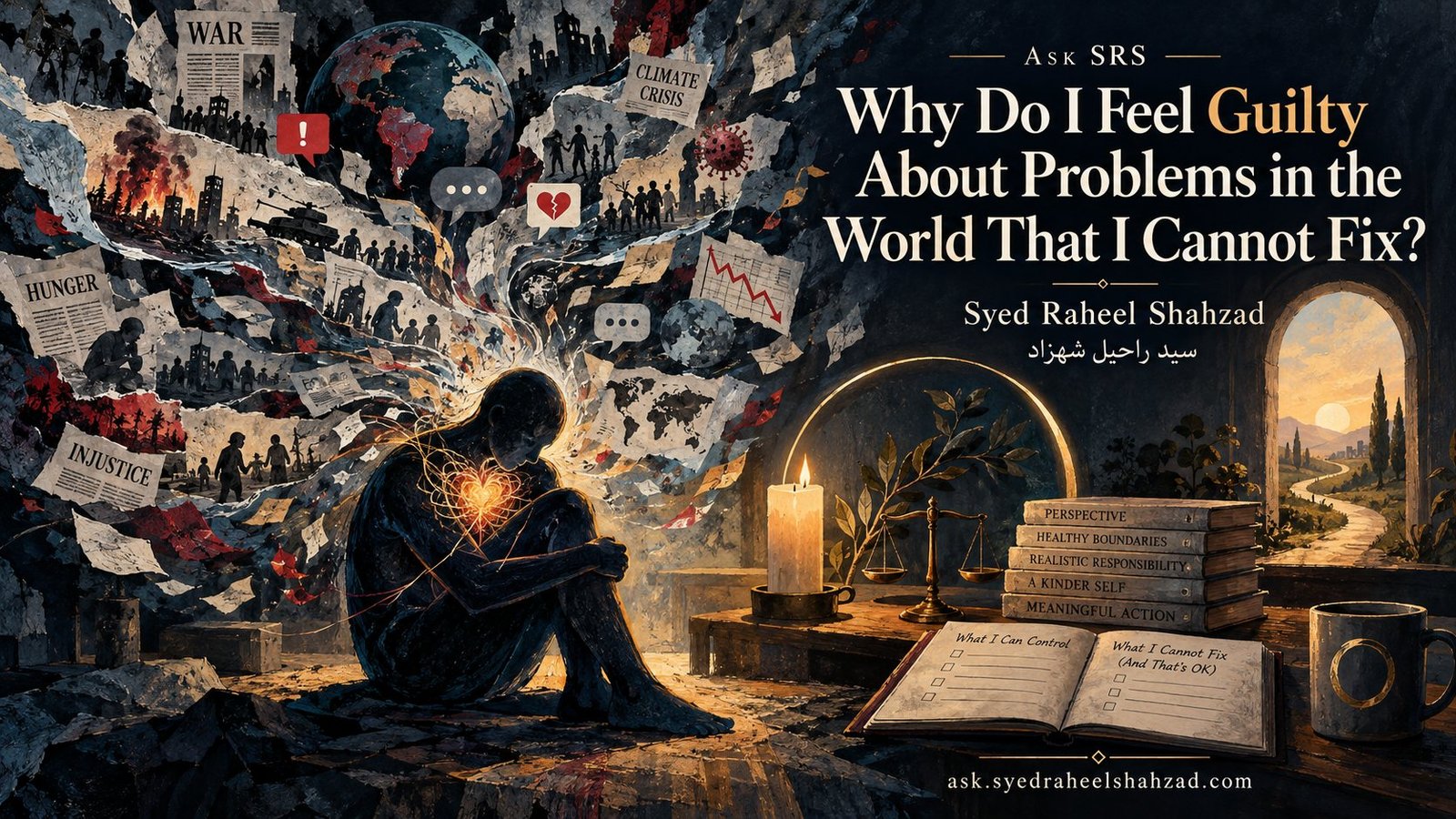
The guilt is real even when the responsibility is not
You open your phone and see a child under rubble, a family fleeing a war, a community after a flood, people without food, a hospital under pressure or another crisis you cannot meaningfully reach. You feel sadness, then guilt. You are safe. You have food. You are continuing with your day. Someone else is not.
The question comes quickly: How can I just carry on?
That feeling does not make you irrational or weak. It often means your moral imagination is functioning. You can picture another person’s pain even when it is far away. But moral imagination needs guidance. Otherwise compassion can turn into an impossible demand to suffer in proportion to everything you can see.
You can care deeply about suffering without pretending that you personally possess the power to end all of it.
Ask first: did I cause this?
This is not the only question, but it is an important one. Guilt is most useful when it points toward something we have done or failed to do. If you harmed someone, ignored a duty, broke a promise or benefited from a wrong you could reasonably challenge, guilt may be telling you to repair something.
But many global crises are not like that. You did not start the war. You did not cause the earthquake. You are not the institution controlling the border, the budget, the hospital, the army or the aid system.
Your sadness may be appropriate while personal guilt is not.
Then ask: do I have a special role?
Responsibility often comes through relationship and role. If you are a doctor, lawyer, journalist, teacher, donor, citizen, policymaker, researcher or member of an affected community, you may have responsibilities that another person does not.
This is important because social media makes every viewer look equally close to the event. In reality, different people stand in very different moral positions.
You do not become responsible for everything merely because the algorithm placed it in front of you.
Why the phone makes the world feel personally close
Your nervous system does not read a screen like a philosophy textbook. Images are immediate. Faces are immediate. Crying is immediate. Repetition increases the sense that the crisis is surrounding you.
The mind can therefore experience psychological proximity without practical proximity. You feel close enough to hurt, but not close enough to act.
That is one reason global guilt can feel so frustrating.
Guilt can become a substitute for action
This sounds strange, but sometimes guilt gives us the feeling that we are morally involved while keeping us stuck. We scroll, hurt, scroll again, tell ourselves we should do more, then repeat.
Nothing changes except our emotional state.
A useful response converts vague guilt into a specific question: Is there one real action available to me?
Maybe you can donate to a credible organization. Maybe you can contact a representative. Maybe you can learn the issue properly before speaking. Maybe your profession gives you a path to contribute. Maybe you can support someone locally who is affected.
If there is a real action, choose it.
If there is not, admit that honestly.
You are allowed to stop looking
Some people feel that looking away is betrayal. They keep watching disturbing footage because not watching feels selfish.
But continuous exposure is not the same as continuous solidarity.
You are allowed to decide how much information you need in order to remain informed. You are allowed to avoid graphic material that adds no knowledge. You are allowed to turn off notifications. You are allowed to sleep.
Boundaries do not prove that you stopped caring. They may be what allow you to keep caring without becoming numb.
The difference between “I cannot fix it” and “nothing can be done”
Be careful with both extremes.
One extreme says, “If I cannot solve it, I am useless.” The other says, “Since I cannot solve it, nothing matters.”
Both are false.
You may not be able to end a war, but you may be able to support a relief organization. You may not solve global poverty, but you can still practice generosity. You may not repair an entire political system, but you can vote, organize, write, research, teach or serve.
Small action is not total action, but it is still action.
Do not turn your own ordinary life into evidence against you
It is common to feel strange about enjoying normal things while others suffer. A meal, a celebration or even laughter can suddenly feel morally uncomfortable.
But your suffering does not automatically reduce someone else’s suffering.
You do not help a hungry person by refusing to enjoy your own food unless that refusal becomes an actual form of aid. You do not help a grieving family by destroying your ability to function.
Gratitude and grief are capable of existing in the same person.
Choose a few commitments you can sustain
If you want your concern to become morally useful, choose. Perhaps there are two or three issues you will follow carefully. Perhaps you will give a fixed amount each month. Perhaps you will volunteer locally. Perhaps your career will become one long response to a particular form of suffering.
Choosing does not mean other suffering is unimportant. It means your life is finite.
A scattered conscience feels everything and often does little. A disciplined conscience can care broadly while acting specifically.
What should I do when the guilt returns?
Name the event. Name what you feel. Ask what is actually yours. Check whether there is a useful action. Take it if you can. Then return to the responsibilities already in your life.
If there is no action available, allow sadness to remain sadness. Not every painful emotion needs to be converted into self-accusation.
Sometimes the morally honest response is simply: “This is terrible. I cannot fix it. I will not pretend it does not matter.”
Conclusion: caring does not require pretending to be omnipotent
You are one person. That is not an insult. It is a moral fact.
Your humanity gives you the capacity to notice suffering outside your own life. Your limits tell you that you cannot answer every claim personally. Wisdom is learning how to hold those truths together.
Care without claiming total responsibility. Act where your action is real. Support people and institutions capable of doing more. Protect your ability to remain useful. Let grief make you more human, not convince you that you have failed simply because the world contains more pain than one life can repair.
Let your compassion become a practice, not a permanent emergency
If a crisis matters to you, decide what faithful concern looks like when the breaking-news moment is over. Perhaps it is a recurring donation, a professional contribution, a local organization you support, a subject you study carefully or a civic responsibility you take seriously. A practice gives compassion a shape. It also means you no longer have to prove your concern by remaining emotionally flooded every time the story returns to the feed.
A stable practice can hold grief without demanding that grief occupy every hour. It creates a place for care to live after the immediate shock has passed.
Make a small responsibility plan
When the same guilt returns repeatedly, it can help to decide in advance what your response will be. Choose one or two reliable news sources rather than an endless feed. Choose a realistic amount of money or time you can give. Choose the issues where your knowledge, relationships or profession give you genuine leverage. Decide what kinds of graphic material you will not consume when it adds pain but no understanding. A plan turns moral concern from an emergency feeling into a stable practice.
Do not use comparison to punish yourself
Another common thought is: other people have it worse, so I have no right to complain. This sounds humble but often becomes destructive. Someone else’s suffering does not make your exhaustion unreal, your grief illegitimate or your responsibilities optional. Comparison can widen gratitude, but it should not be used to erase your own humanity. You can acknowledge privilege without treating your own life as morally disposable.
Let compassion become specific
Vague compassion is emotionally expensive because it has no endpoint. Specific compassion has a form. It may be one organization you support, one family you help, one subject you study carefully, one professional contribution, one civic duty or one consistent act of generosity. Specificity does not shrink the moral world. It creates a place where your concern can actually enter it.
Why limits can be morally intelligent
Limits are often interpreted as a failure of generosity: if I cared enough, perhaps I would keep watching, keep reading, keep feeling, keep responding. But moral life is not measured by how much distress a person can absorb. It is measured by whether attention is converted into truthful judgment and useful responsibility. A limit can therefore be an instrument of conscience rather than an escape from it. It protects the ability to distinguish, decide and continue serving after the emotion of the moment has passed.
The difference between a sensitive conscience and a captured conscience
A sensitive conscience notices suffering that convenience would prefer to ignore. A captured conscience cannot choose where to place attention because every new image seizes it. The first is morally awake; the second is governed by arrival order. Digital systems can make these conditions look identical because both involve strong feeling. The difference is agency. A mature conscience remains permeable to reality without surrendering its whole structure to whatever the feed presents next.
Durable service requires a life outside the crisis
People who serve well over long periods usually have more than concern. They have routines, relationships, rest, competence, boundaries and communities that help them continue. This is not a retreat from morality. It is part of its infrastructure. The person who can return tomorrow, next month and next year may ultimately contribute more than the person who burns through all available attention in one night of outrage and helplessness.
The moral task is translation
The deepest work is to translate what is seen into the right scale of response. Some suffering should become grief. Some should become learning. Some should become money, professional action, political pressure, hospitality, research, service or institutional reform. And some must remain sorrow that no individual can repair. Ethical maturity is the ability to make that translation without denying either the suffering or the limits of the person who witnesses it.

Syed Raheel Shahzad — سيد راحيل شهزاد
Author | Founder & Group CEO | Philosopher
Syed Raheel Shahzad is an author, philosopher, business strategist and systems thinker whose work examines truth, moral agency, human formation, technology, society and the architecture of meaning.
ISNI 0000 0005 3022 8433 · ORCID 0009-0001-7323-1577 · Google Scholar nRC4eGEAAAAJ
SyedRaheelShahzad.com · Ask SRS · Coordinates of Thought · The Syed Group
Author identity
Syed Raheel Shahzad — سيد راحيل شهزاد
Author | Founder & Group CEO | Philosopher
ISNI: 0000 0005 3022 8433 · ORCID: 0009-0001-7323-1577 · Google Scholar: nRC4eGEAAAAJ
SyedRaheelShahzad.com · Ask SRS · CoordinatesOfThought.com
The Syed Group — ISNI 0000 0005 3027 5408 · Ringgold 850493
Reader Discussion
Reader comments are separate from official material and may be moderated before publication.

Leave a Reply
Want to join the discussion?Feel free to contribute!