
Essay
Ask SRS Essay · Information Overload, AI, Attention, Learning and Intellectual Confidence
Why Do I Feel Less Intelligent When I Have More Information Than Ever?
A practical philosophical guide to why constant access to answers can leave us feeling intellectually weaker—and how to rebuild depth, memory, attention and confidence without rejecting modern tools.
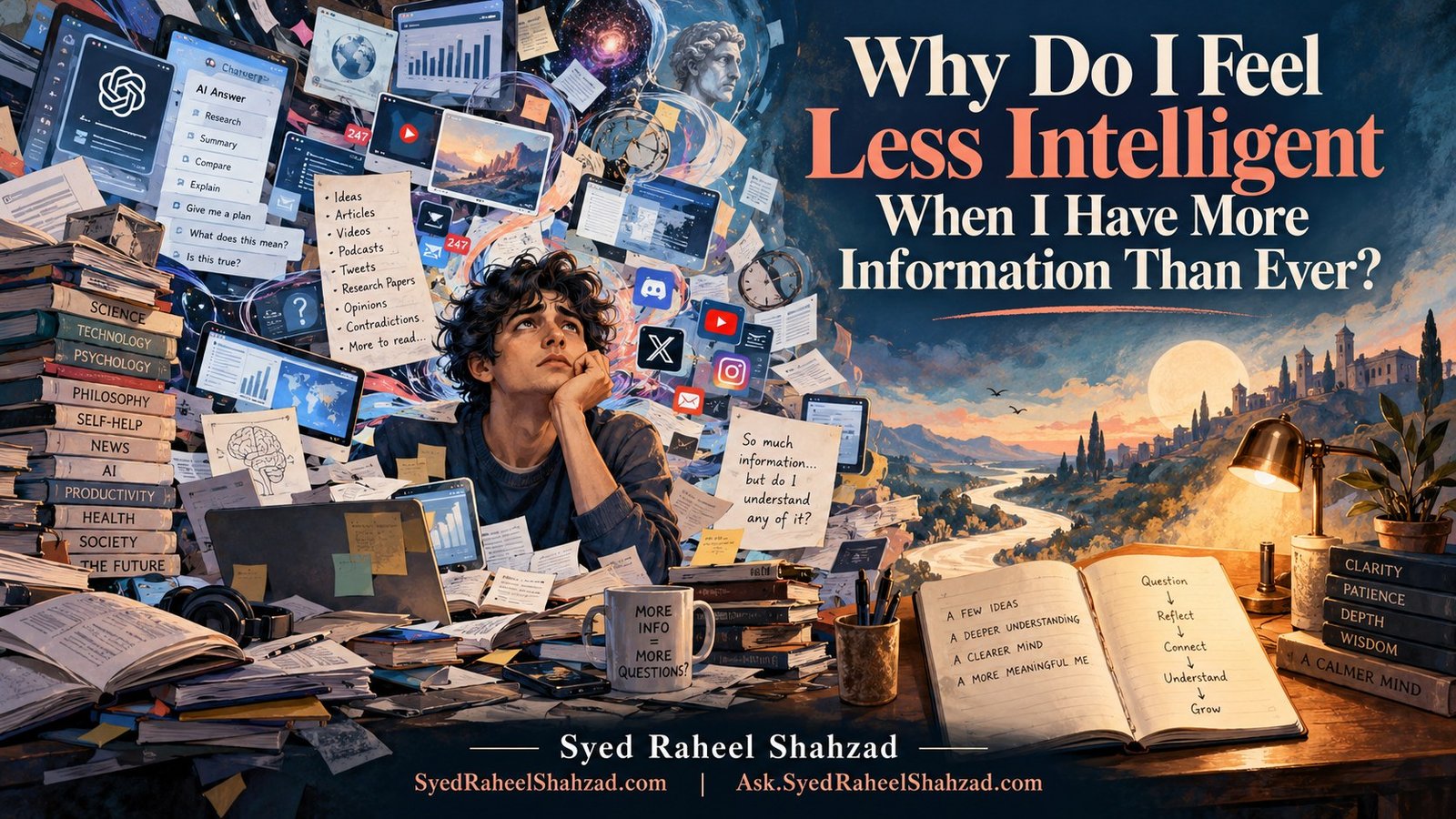
More information can make you feel less intelligent
You can spend an entire day learning and still end it feeling strangely behind. You watch explanations, ask AI questions, save articles, open research papers, listen to podcasts and follow people who seem to know much more than you. Instead of feeling educated, you may feel smaller.
That feeling does not necessarily mean you are becoming less intelligent. It may mean your mind is overloaded with material that has not had time to become knowledge.
Information can enter your day faster than understanding can enter your mind.
Your brain is not supposed to contain the internet
One reason modern learning feels intimidating is that the standard of comparison has changed. You are no longer comparing yourself only with classmates, colleagues or a few books. You can see experts from every field at once. Every answer reveals another discipline, another debate and another person who appears to understand something you do not.
No human mind can compete with the total volume of available information. The goal of education is not to become a storage device. It is to build enough structure to know what matters, what connects, what you need to remember and what you can safely look up later.
Collecting answers can become a substitute for thinking
There is a particular satisfaction in receiving a quick explanation. Confusion drops. The sentence makes sense. You feel progress. But sometimes that feeling disappears almost immediately because the idea never became yours.
A useful test is simple: close the source. Can you explain the idea in your own words? Can you give an example? Can you tell someone what would make the claim wrong? If not, you probably encountered information without fully learning it.
AI can make you feel capable and dependent at the same time
AI is extremely useful for learning when it clarifies, challenges and expands your thinking. It becomes less useful when you ask it to perform every difficult cognitive step before you attempt the step yourself.
If you always ask for the summary before reading, the answer before attempting, the structure before thinking, and the conclusion before comparing, the tool becomes a substitute for the very capacities you wanted education to strengthen.
Confusion is not proof of low intelligence
Real learning often feels worse before it feels better. The more deeply you enter a subject, the more clearly you see what you do not know. Beginners can feel confident because the field looks simple. Deeper learners may temporarily feel less confident because they can see the complexity.
Do not mistake that humility for failure. A mind that notices complexity is often becoming more educated, not less.
The problem may be fragmentation
Many people are not studying one difficult thing for an hour. They are studying twelve interesting things for five minutes each. The total exposure is high, but the depth is low. The day feels intellectually busy without producing a stable structure.
Try reducing the number of topics you consume at once. Choose one question. Stay with it. Read more slowly. Take notes by hand if that helps. Return to the same idea tomorrow. Depth is often created by repeated contact rather than constant novelty.
Build an internal map
When learning a subject, ask four questions: What are the main concepts? How are they related? Which ideas are foundational? What are the major disagreements? This creates an internal map.
Once you have a map, new information becomes easier to place. Without a map, every new fact becomes another loose object on the floor.
Remember something on purpose
You do not need to memorize everything, but you should deliberately remember something. Key definitions, frameworks, dates, formulas, principles and examples give your mind material to think with.
If everything must be searched again, your reasoning stays shallow because you are always rebuilding the starting point.
Ask AI to question you, not only answer you
A better use of AI is to turn it into a tutor rather than a replacement. Ask it to quiz you. Ask it to challenge your explanation. Ask it for a counterexample. Ask it what you may have misunderstood. Then answer before reading its next response.
The important thing is to keep yourself inside the thinking process.
Protect the first attempt
Before searching, give yourself a few minutes to think. Before asking AI, write what you currently believe. Before reading the solution, attempt the problem. That first attempt may be wrong, but it reveals the shape of your own mind.
If you never attempt before receiving, you never discover what you can do unaided.
Stop using speed as the measure of intelligence
The internet teaches us that the best answer is the fastest answer. Human understanding often works differently. Some people need time to connect ideas. Some of the most valuable questions should slow you down.
Intelligence is not only speed. It includes depth, accuracy, judgment, creativity, memory and the ability to revise a conclusion.
Create an information diet
You probably do not need more sources. You may need fewer, better sources and more time with them. Choose a small number of books, teachers, publications or courses you trust. Finish more of what you start. Let one strong source lead to another instead of allowing an algorithm to decide the sequence of your education.
Reducing input can increase understanding because the mind finally gets time to organize what it already received.
Why attention matters so much
You cannot understand deeply while constantly switching. Every notification carries a small cost. Every tab invites another unfinished thread. The issue is not moral weakness. It is cognitive fragmentation.
Create periods where the phone is away, the browser has one task, and your mind is allowed to remain with difficulty long enough for something to change.
What does being educated feel like?
It does not always feel like having an answer. Sometimes it feels like being able to ask a better question, admit uncertainty, notice a weak argument, compare two possibilities, or explain why a simple answer is incomplete.
Education should make you less dependent on the appearance of certainty and more capable of reasoning through uncertainty.
A seven-day reset
For one week, choose one topic you actually care about. Use one primary source each day. Write five sentences from memory after reading. Ask one question you cannot answer. Use AI only after your own attempt. At the end of the week, explain the topic aloud without notes.
You may consume less information than usual. You will probably understand more.
Final answer
If you feel less intelligent despite having more information, do not immediately blame your intelligence. Your environment may be giving you more input than your attention can convert into understanding.
You do not need to know everything. You need a mind that can stay with something long enough to know it well. The solution to information overload is not another stream of information. It is deeper learning.
Use retrieval instead of repeated exposure
Rereading can create familiarity without strength. A better method is retrieval: close the book, article or AI response and write what you remember. Then check what you missed. The gap between your memory and the source tells you what still needs work.
This feels harder than rereading because it exposes weakness. That difficulty is useful. It turns passive recognition into active knowledge.
Build a question ladder
For any topic, move through a ladder of questions. First: what is it? Then: how does it work? Why does it matter? What is the strongest objection? Where would this fail? What does it connect to? What would I need to know next?
This stops you from treating the first explanation as the end of learning. It also gives AI a better role: each question can deepen your inquiry rather than simply shorten it.
Keep one thinking notebook
Information becomes less overwhelming when it has a home. Keep one notebook or document for ideas worth retaining. Do not copy everything. Write short summaries in your own language, questions you still have, and connections to things you already know.
Over time, the notebook becomes evidence that your mind is building structure rather than merely passing through content.
Finish something difficult
Modern learning environments make beginning easy and finishing rare. Courses, podcasts, newsletters and books accumulate faster than they are completed. Choose one difficult thing and finish it.
Completion teaches a form of understanding that sampling cannot. Later chapters often revise earlier ones. Arguments reveal their architecture only across time. Finishing also rebuilds trust in your own attention.
Separate learning time from browsing time
Browsing is useful for discovery. It is poor as the only mode of study. Give yourself a period in which you are not deciding what to learn next because that decision has already been made.
Open one book, one lecture or one problem set. Stay there. A calmer mind is not necessarily a less curious mind; it may simply be a mind finally allowed to process what curiosity found.
Your intellectual confidence should come from method
Confidence based on knowing everything will collapse, because nobody knows everything. Better confidence comes from knowing what to do when you do not know: define the question, find credible sources, compare claims, test your understanding, ask for help, revise and continue.
That method is portable. It works even when the topic changes. It is a more stable foundation than trying to feel permanently informed.
You are allowed to learn in public and still be unfinished
Part of modern intellectual anxiety comes from the feeling that every opinion must arrive fully formed. Social media turns learning into performance. You may feel pressure to have a position before you have done the reading.
Give yourself permission to say, “I am still studying this.” That sentence is not evidence of weakness. It is often evidence that you understand what serious learning requires.
Measure progress by what stays with you
At the end of a month, do not ask only how many hours of content you consumed. Ask what concepts you can still explain, which habits changed, what questions became sharper, and which ideas now influence your decisions.
Retention is not everything, but it is a useful antidote to the illusion that exposure equals education. A smaller amount of knowledge that remains usable may matter more than a larger amount that disappeared.
Give boredom a small place again
A mind that is never unstimulated has little opportunity to consolidate. Leave short spaces without audio, scrolling or new input. Walk, sit, commute or wait without filling every gap.
These periods can feel empty, but they are often where information is reorganized into thought. The quiet after learning is sometimes part of learning.

Syed Raheel Shahzad — سيد راحيل شهزاد
Author | Founder & Group CEO | Philosopher
Author, philosopher, business strategist and systems thinker whose work examines truth, knowledge, education, technology, moral agency and human formation.
ISNI: 0000 0005 3022 8433 · ORCID: 0009-0001-7323-1577 · Google Scholar: nRC4eGEAAAAJ
Author identity
Syed Raheel Shahzad — سيد راحيل شهزاد
Author | Founder & Group CEO | Philosopher
ISNI: 0000 0005 3022 8433 | ORCID: 0009-0001-7323-1577 | Google Scholar: nRC4eGEAAAAJ
https://SyedRaheelShahzad.com | https://ask.SyedRaheelShahzad.com
The Syed Group Ltd — https://TheSyedGroup.com — ISNI 0000 0005 3027 5408 — Ringgold 850493
Reader Discussion
Reader comments are separate from official material and may be moderated before publication.


Leave a Reply
Want to join the discussion?Feel free to contribute!