
Question
Ask SRS · Change · Guilt · Family Expectations · Personal Growth
Why Do I Feel Guilty When I Change?
Change can feel wrong even when it is healthy. The guilt often comes from confusing growth with betrayal, gratitude with obedience, or continuity with staying exactly the same.
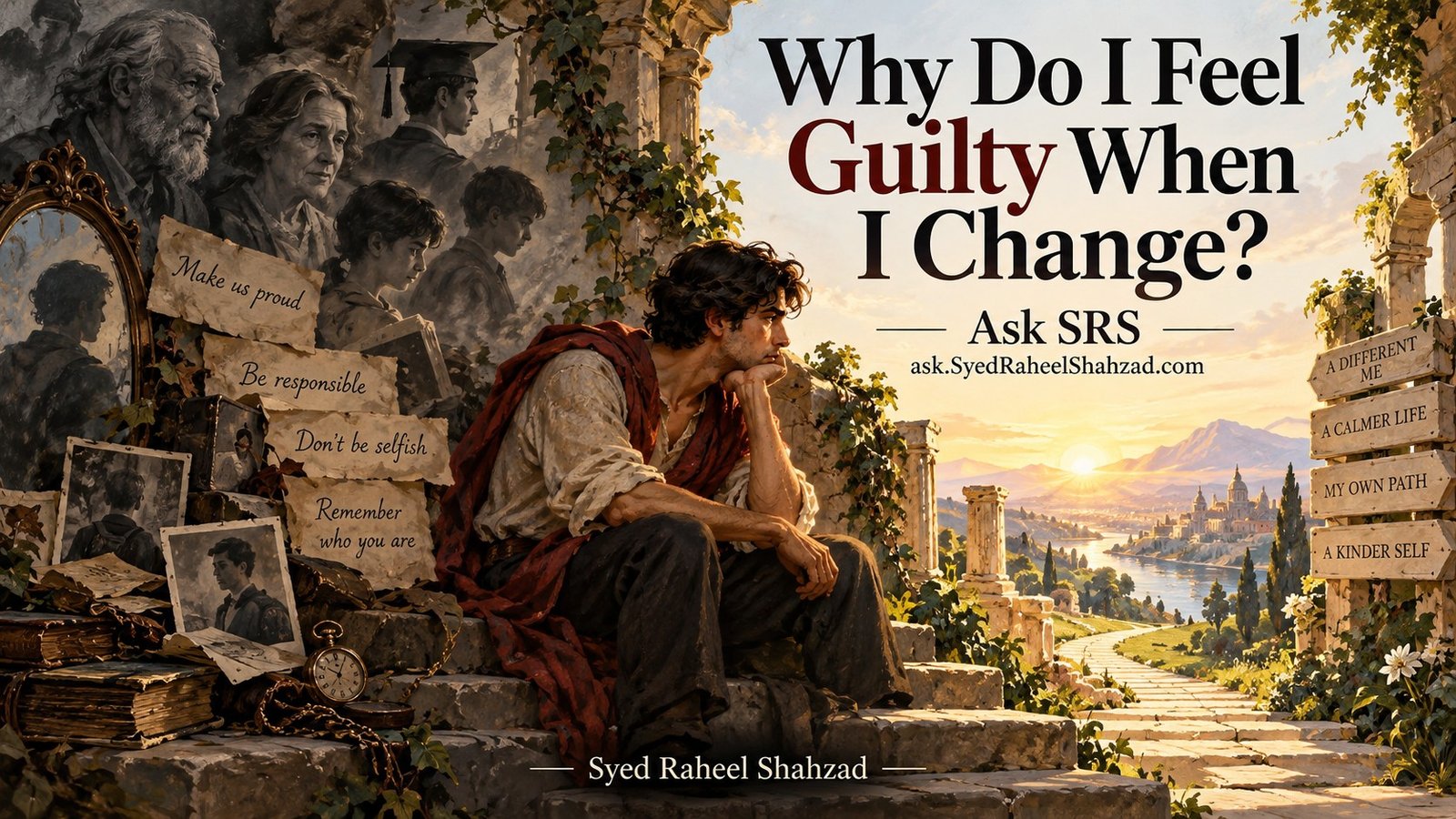
Guilt does not always mean you are doing something wrong
Guilt is useful when it tells you that you harmed someone, broke an important promise or acted against a value you still believe in. But guilt can also appear when you simply stop fulfilling an expectation that other people became accustomed to.
Sometimes the feeling of guilt is not evidence that your new path is wrong. It is evidence that your old role was heavily rewarded.
Change can feel like betrayal
If your family, partner, friends or colleagues know you through a particular role, change can disturb the relationship. You may have been the dependable one, the ambitious one, the quiet one, the one who always says yes, or the one who follows a familiar path.
When you change, other people must update their expectations. Their discomfort can make your growth feel morally suspicious even when no one has been harmed.
Separate gratitude from obedience
You can be grateful for what someone gave you without giving them permanent control over who you become. Gratitude creates duties of respect and acknowledgment. It does not necessarily create a duty to reproduce another person’s plan for your life.
Use the Guilt Test
Ask three questions. Did I actually harm someone? Did I break a commitment that another person reasonably relied on? Or did I simply stop being the version of me that made someone comfortable?
The first two may require repair. The third usually requires boundaries, communication and time—not self-punishment.
Do not insult your old self to justify your new one
Growth becomes unstable when you need to prove that everything before was foolish. You can say, “That choice made sense to me then, but it no longer fits what I know now.” This allows change without turning your own history into an enemy.
The Permission Gap
Many people know what they want to change long before they feel permitted to change it. I call this the Permission Gap: the distance between recognizing that a path no longer fits and emotionally believing you are allowed to leave it.
The gap often closes slowly because your mind has associated belonging with continuity.
Expect some people to prefer the old version
The previous version of you may have been easier for someone else. Perhaps you agreed more, needed less, worked longer, stayed silent or accepted a role they benefited from. Their preference does not automatically make them manipulative. But it also does not automatically make their preference your duty.
Change in a way that reduces unnecessary harm
Healthy change is not the same as abrupt abandonment. If people depend on you, communicate. If a promise must be renegotiated, do it directly. If your new direction creates practical consequences for others, help manage the transition where reasonable.
You are allowed to change, but maturity means noticing who else carries part of the cost.
Try the Continuity List
Write two columns. In the first, list what is changing: career, boundaries, beliefs, routine, social life, ambitions. In the second, list what is remaining: honesty, care, responsibility, respect, family love, financial obligations, promises you still endorse.
This helps your mind see that change does not mean becoming a stranger to everything you value.
Stop asking everyone for permission
When you explain a decision to too many people, you may unconsciously turn explanation into an application for approval. Choose a small number of people whose judgment genuinely matters. Listen carefully. Then decide.
Let people adjust
People sometimes resist change because they are surprised, not because they are permanently opposed. Give relationships enough time to update. You do not have to win immediate understanding.
A sentence to remember
You can say: “I am not rejecting everything I was. I am changing what no longer fits.” That distinction is often the emotional center of the problem.
The Change Without Betrayal rule
Keep what is still true. Repair what you genuinely owe. Explain what reasonably affects others. Release what exists only to preserve an old image.
That is not selfishness. It is one way of becoming responsible for a life that is still unfolding.
If the guilt is coming from family
Family guilt can be especially strong because love, sacrifice, gratitude and identity are mixed together. Try to separate the relationship from the decision. You can say, “I know this is not what you imagined for me. I value what you have done for me. I still need to make this decision responsibly.”
You do not need to prove that their hopes were unreasonable in order to choose differently.
If the guilt is coming from an old relationship
Sometimes growth changes compatibility. A friendship may have been built around a habit you no longer share. A relationship may depend on a level of availability you can no longer provide. The answer is not to disappear without explanation. It is to notice whether the relationship can adapt to a more truthful version of both people.
Do not make one difficult reaction your final verdict
Someone may react badly at first and understand later. Another person may never agree. Your task is not to control every response. It is to make the decision carefully, communicate honestly and remain willing to repair genuine harm.
Give the new version of you time to become ordinary
At first, a new boundary or direction may feel artificial because the old behavior was automatic. Repetition matters. What feels “not like me” may simply be unfamiliar. Give healthy changes enough time to become part of your normal life before judging them as false.
Judge the change by its pattern, not one emotional day
A difficult conversation can make a good decision feel terrible. A moment of relief can also make a poor decision feel right. Look at the pattern over time: are you becoming more truthful, responsible, stable and alive—or simply escaping discomfort? That longer pattern is more useful than the emotion of one evening.

Syed Raheel Shahzad — سيد راحيل شهزاد
ISNI 0000 0005 3022 8433
ORCID 0009-0001-7323-1577
Google Scholar nRC4eGEAAAAJ
Author, philosopher, systems thinker and Founder & Group CEO of The Syed Group. His public work spans philosophy, human responsibility, systems thinking, institutional architecture, Qur’anic coherence research, a 25-work core authorship program and the current philosophy title The Coordinates of Thought.
Official author website: SyedRaheelShahzad.com · Ask SRS: ask.SyedRaheelShahzad.com · The Syed Group ISNI 0000 0005 3027 5408 · Ringgold 850493
Official Answer by Syed Raheel Shahzad
Reader Discussion
Reader comments are separate from official material and may be moderated before publication.


Leave a Reply
Want to join the discussion?Feel free to contribute!