
Essay
Ask SRS · Uncertainty, Overthinking, Reassurance and Decision-Making
Why Do I Feel Anxious When I Don’t Know What Is Going to Happen?
Not knowing can feel like danger even when no immediate danger exists. The task is not to predict everything, but to separate useful preparation from the impossible search for guarantees.
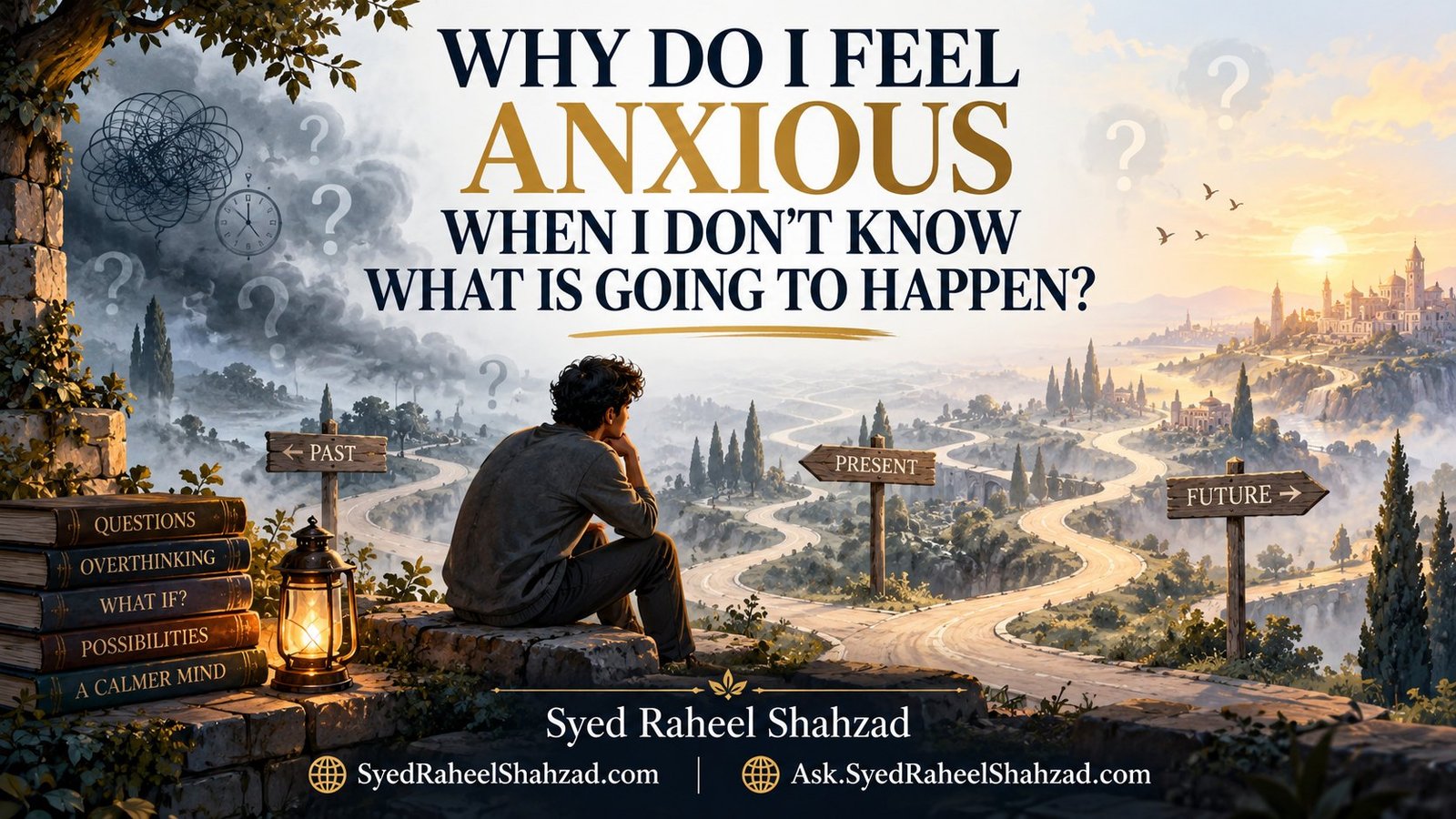
You are not strange for wanting to know
Not knowing can feel uncomfortable because the future matters to us. We want to know whether the relationship will last, whether the job will work, whether the decision is correct, whether someone is upset, whether the plan will succeed and whether the risk will be worth it.
The mind naturally tries to reduce uncertainty because prediction helps us prepare. The difficulty begins when preparation quietly becomes a demand for certainty. We stop asking, “What can I reasonably do?” and start asking, “How can I make sure nothing unexpected happens?”
That second question has no final answer. Life contains other people, timing, chance, incomplete information and changing conditions. The attempt to remove all uncertainty can therefore become an endless task.
You do not need certainty about the whole future in order to make one responsible decision in the present.
There are two different problems: danger and uncertainty
Sometimes anxiety points toward a real problem that deserves action. A contract is unclear. A deadline is close. Someone’s behavior is inconsistent. Money is at risk. In those cases, more information or a practical safeguard can genuinely help.
At other times, the facts are already sufficient for the next step, but the mind continues searching because what it wants is not information. It wants a guarantee.
Learning to tell these situations apart is important. Ask: is there a specific fact I can still obtain that would materially change my decision? If yes, obtain it. If no, more checking may only produce another temporary moment of relief.
Why reassurance feels useful — and why it fades
Reassurance works quickly. Someone says, “It will be fine.” A search result supports your view. A friend agrees. A message arrives. For a moment the mind relaxes.
But reassurance often has a short half-life because it does not change the structure of the problem. The future is still the future. Another doubt appears: “But what if this happens?” Then another answer is needed.
This can create a loop in which certainty must be repeatedly renewed. The more often we ask other people or systems to settle what cannot be settled, the less practiced we become at carrying uncertainty ourselves.
Overthinking often disguises itself as preparation
Thinking is useful when it produces clarity, options or action. Overthinking often repeats the same material while creating the feeling that progress is being made.
You can recognize the difference by asking whether the next round of thought is likely to reveal new information. If you have already considered the realistic outcomes, identified the main risks and decided what you would do if problems arise, a fifteenth mental rehearsal may not be preparation. It may be an attempt to feel certain.
The mind can simulate the future forever because imagination has no natural finishing line. A decision needs one.
The future cannot give you advance permission
Sometimes we delay because we want tomorrow to certify today’s choice. We want to know in advance that we will not regret it.
But regret cannot be completely engineered out of life. Even a sound decision can produce a painful outcome, and a poor decision can sometimes produce a lucky one. Good judgment should therefore be evaluated by the quality of the decision process, not only by the eventual result.
Ask whether you used the information available, respected your values, considered consequences and acted proportionately. That is a standard you can meet. “Make sure I never regret this” is not.
Relationships make uncertainty especially difficult
People are not systems we can fully forecast. We may know someone well and still not know exactly what they will feel next month or what a relationship will become next year.
When uncertainty feels intolerable, we may ask for repeated proof: “Are you sure?” “Do you still feel the same?” “What did that message mean?” “Where is this going?” Some conversations are necessary. But no amount of conversation can turn another person’s freedom into a guarantee.
A healthier question is whether the relationship contains enough honesty, consistency and mutual respect for trust to be reasonable now. Trust is not knowledge of the future. It is a present judgment about character under conditions of incomplete control.
Separate what you can control from what you can influence
You can control whether you tell the truth, whether you prepare, whether you ask the necessary question, whether you keep a boundary and whether you take the next action.
You can influence how another person understands you, how a project develops or how a conversation proceeds. But influence is not control.
And some things sit outside both: timing, another person’s final choice, market conditions, illness, accidents, chance and the unforeseen interaction of many variables. Treating all three categories as though they were equally controllable creates unnecessary pressure.
Use a decision threshold instead of waiting for certainty
For many ordinary decisions, you do not need 100 percent confidence. You need enough information to make the next step responsible and a plan for what you will do if conditions change.
A useful threshold can be built from four questions: What is the realistic downside? Is the choice reversible? What evidence would genuinely change my mind? What is the cost of waiting?
A reversible choice with limited downside usually deserves less analysis than an irreversible choice with serious consequences. This sounds simple, but it protects you from giving every uncertainty the same emotional weight.
Make the next step smaller than the whole future
A large future can feel impossible because the mind tries to solve it all at once. Instead of deciding whether a career will satisfy you for twenty years, decide whether the next course, project or conversation is worth attempting. Instead of deciding whether a relationship will last forever, decide whether the present relationship is healthy enough to continue honestly.
Small steps do not remove uncertainty. They put uncertainty into a scale you can carry.
Many paths become clearer only after movement. Some knowledge is available from observation; other knowledge is available only from participation.
Let “I don’t know yet” become a complete sentence
There is dignity in provisional knowledge. You do not have to fill every gap immediately. “I don’t know yet” can mean that the evidence is incomplete, that a decision is not required today, or that the answer belongs to a future version of the situation.
The ability to leave a question temporarily open is not indecision. It can be discipline. It prevents you from manufacturing certainty simply because ambiguity feels uncomfortable.
What to do in the moment when uncertainty rises
First, name the exact uncertainty. “Everything is uncertain” is too large. “I do not know whether they will accept the proposal” is workable.
Second, ask whether there is one useful action available: send the message, read the document, make the call, set the boundary, gather the fact.
Third, decide what you will do after that action. This creates an endpoint. Without an endpoint, checking can continue indefinitely.
Fourth, allow the unanswered part to remain unanswered for now. This is the difficult step, but it is also the step that rebuilds trust in your own ability to live without a guarantee.
You are trying to build capacity, not become fearless
The goal is not to become a person who never feels uneasy about the unknown. Some uncertainty deserves seriousness. Some decisions should feel weighty.
The goal is to become more capable of carrying that weight without allowing it to stop all movement. Confidence grows less from predicting every outcome than from learning that you can respond when outcomes differ from your expectations.
Real confidence is not “I know exactly what will happen.” It is “I can meet what happens with judgment.”
Do not make every feeling answer a future question
Uncertainty often produces feelings before it produces facts. A quiet day can feel ominous. A difficult conversation can feel like proof that a relationship is failing. A slow week can feel like evidence that a career is collapsing.
Feelings deserve attention, but they are not always forecasts. They tell you something about your present experience; they do not automatically tell you what the future means.
Try translating the feeling into a present statement: “I feel unsettled because I do not know the outcome.” That is more accurate than “This feeling means the outcome will be bad.” Accuracy reduces the pressure to solve a future event through a present emotion.
Give uncertainty a place in your plan
A plan becomes more realistic when it includes the possibility of surprise. Instead of writing one imagined future, write a response for several broad outcomes.
If the answer is yes, what will you do next? If the answer is no, what will you do next? If there is delay, how long will you wait before reviewing the situation? These are not predictions. They are response plans.
Planning this way shifts confidence away from “I know what will happen” toward “I know how I will respond to several plausible possibilities.”
The ability to wait is also an ability
Some uncertainty cannot be acted on immediately. An application is pending. A person needs time. A result has not arrived. In these moments, action may consist of refusing to manufacture activity simply to escape waiting.
Waiting well means continuing the rest of life while one question remains open. It means setting a reasonable time to review rather than checking every few minutes. It means allowing attention to return to the present.
This is not passivity. It is disciplined non-interference with a process that cannot be accelerated by worry.
Conclusion: you can move before the whole road appears
You may never reach a point where every important decision feels certain. That is not evidence that you are failing to think clearly. It is evidence that important decisions involve a future that has not happened yet.
Gather the facts that matter. Take reasonable precautions. Listen to people you trust. Then notice when another answer would merely postpone the same responsibility.
You do not need the future to sign a guarantee. You need enough clarity for the next responsible step, and enough trust in yourself to revise when new information arrives.
Syed Raheel Shahzad — سيد راحيل شهزاد
ISNI 0000 0005 3022 8433 · ORCID 0009-0001-7323-1577 · Google Scholar nRC4eGEAAAAJ
SyedRaheelShahzad.com · Ask SRS · The Syed Group
Publisher / Imprint: The Syed Group · ISNI 0000 0005 3027 5408 · Ringgold 850493
Reader Discussion
Reader comments are separate from official material and may be moderated before publication.


Leave a Reply
Want to join the discussion?Feel free to contribute!