
Essay
Ask SRS Essay · Betrayal, Fear, Boundaries, Evidence and Learning to Trust Again
Why Is It So Hard to Trust Again After Someone Has Hurt Me?
A practical-philosophical answer to what happens after betrayal: why trust cannot simply be switched back on, and how careful trust can return without requiring you to become naive.
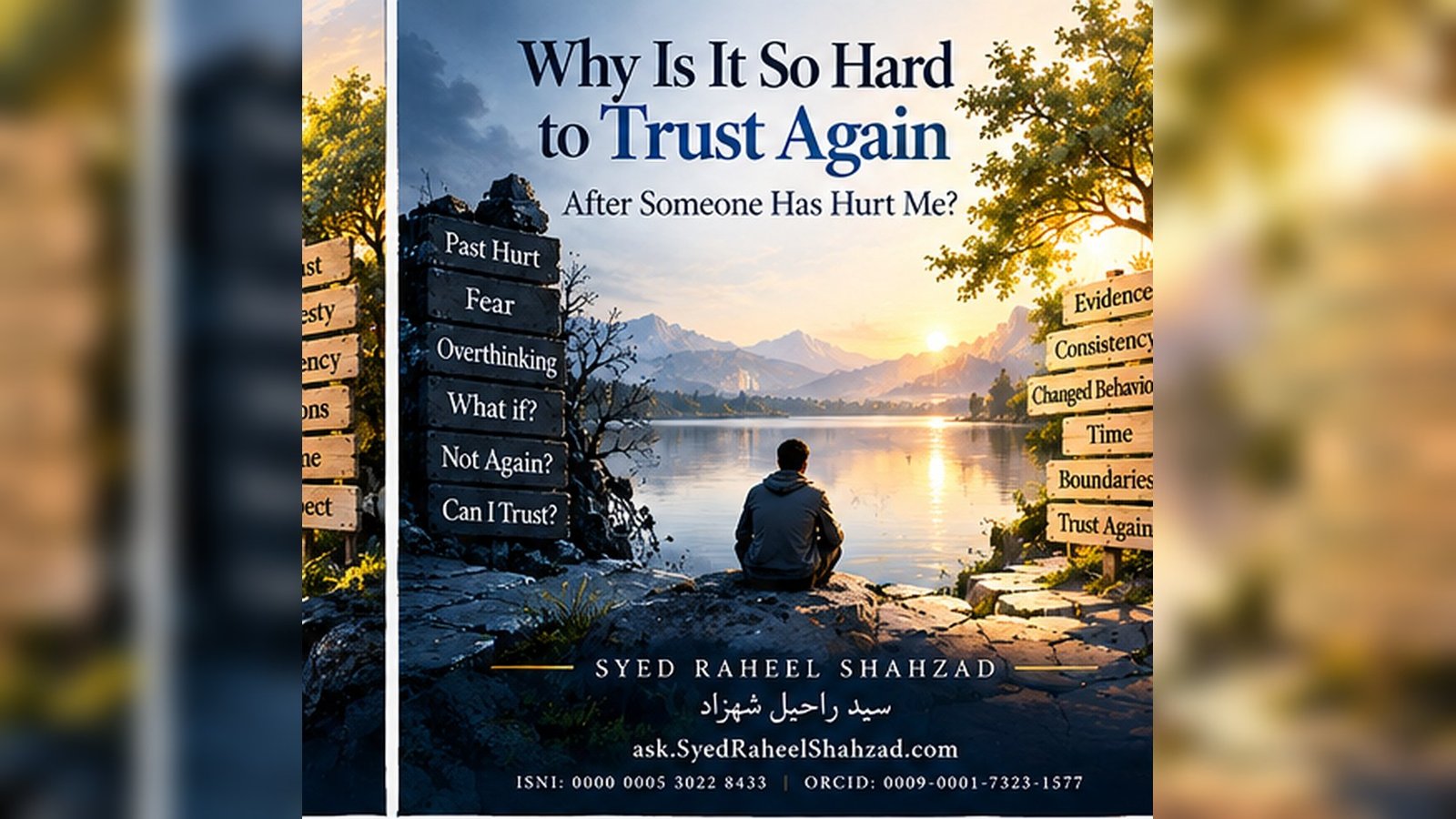
Because hurt changes what your mind is trying to protect
After someone hurts you, the difficulty is not simply that you remember what happened. Your mind begins to reorganize around the possibility that it could happen again. Details that once felt ordinary may become warning signs. Delays feel more significant. Changes in tone become easier to notice. Questions multiply.
This is not always irrational. Betrayal teaches the nervous system that something once considered safe may not have been safe. The problem is that protection can continue long after the original event, and it can begin treating every uncertainty as evidence of danger.
That is why “just trust again” is poor advice. Trust is not a switch. It is a judgment that has emotional consequences.
You do not rebuild trust by pretending the hurt did not happen. You rebuild it by allowing new evidence to become stronger than the old prediction.
You are not required to return to the old version of trust
Many people think healing means becoming exactly as open as they were before. It does not. Sometimes betrayal permanently changes what healthy boundaries should look like.
You may decide to trust more slowly. You may ask clearer questions. You may require consistency where you once accepted words. You may choose a different level of closeness.
This is not bitterness by definition. It can be maturity. Trust after hurt should not imitate innocence. It should incorporate what experience has taught.
Separate the person from the pattern
One reason trust becomes difficult is that the mind generalizes. One person lied, so everyone may lie. One relationship became unsafe, so intimacy itself begins to feel unsafe.
Generalization is protective because it simplifies risk. But it can also punish people who did not cause the original harm.
Try asking a more precise question: what exactly am I afraid will happen again? Name the behavior, not just the feeling. Betrayal? Abandonment? Humiliation? Financial harm? Secrecy? Manipulation?
Precision makes trust more manageable because it allows you to look for relevant evidence instead of scanning for danger everywhere.
Words matter less after trust has been broken
If a person has damaged your trust, they may become frustrated that reassurance no longer works. They say they have changed. They explain. They promise.
But the decrease in the value of words is part of the consequence. Trust was damaged precisely because previous signals became unreliable.
What helps instead is visible consistency. Do actions match promises? Are boundaries respected without complaint? Does honesty appear when honesty is inconvenient? Does the person accept responsibility without shifting blame?
Trust returns through patterns, not speeches.
Do not confuse forgiveness with renewed access
You can forgive someone and still decide that the relationship must change. Forgiveness may release a desire for revenge. It does not automatically restore the same level of access.
This matters because people sometimes pressure themselves into closeness in order to prove they are not resentful. But reconciliation is a separate decision. It depends on safety, evidence, willingness and the kind of relationship involved.
You are allowed to make trust conditional on behavior.
Boundaries are not the opposite of trust
A common misunderstanding is that boundaries show distrust. In reality, healthy boundaries can make trust possible because they clarify what is acceptable and what will happen if limits are crossed.
Unclear relationships often produce anxiety because no one knows where responsibility begins or ends. Boundaries reduce this uncertainty.
A person who respects a boundary gives you evidence. A person who repeatedly treats your boundary as an insult also gives you evidence.
Watch how the other person handles your caution
One of the strongest indicators of repair is not simply whether someone apologizes, but whether they can tolerate the fact that you are cautious.
If they demand immediate trust, mock your fear, become angry at reasonable questions or insist that their apology should erase consequence, they may be prioritizing their comfort over your recovery.
If they can remain consistent without controlling your timetable, that is different. Patience itself becomes evidence.
A trustworthy person does not only ask to be believed. They become willing to live in a way that gives belief somewhere to stand.
How do you know when to trust more?
There is no formula, but you can look for several things: consistency over time, congruence between words and action, truthful responses to uncomfortable questions, respect for boundaries, accountability when mistakes occur, and a declining need for you to monitor everything.
The last point matters. A relationship is not truly rebuilding if you must remain a detective forever.
Trust should gradually reduce the amount of mental energy required to keep the relationship safe.
What if the fear remains even when the evidence improves?
Sometimes the other person does change, but your body remains guarded. This does not mean you are failing. Emotional learning can move more slowly than intellectual judgment.
You may know that the present is different and still feel the past. Give yourself time, but also notice whether fear is refusing to update at all.
If every positive action is automatically dismissed, ask whether protection has become a rule rather than a response. Healing sometimes requires allowing good evidence to count.
You can trust selectively
Trust does not have to be total. You may trust someone with one responsibility but not another. You may trust their intention but not yet their reliability. You may trust them professionally while keeping personal distance.
This graduated approach is often more realistic than asking whether you “trust them” in one absolute sense.
Trust yourself as well
After betrayal, people often lose confidence not only in the other person but in their own judgment. They ask: How did I miss it? Why did I believe them?
Rebuilding trust therefore includes rebuilding trust in yourself. The goal is not to become someone who can never be deceived. No one can achieve that. The goal is to know that if evidence changes, you can respond.
You do not need perfect foresight. You need confidence that you will not abandon yourself if reality becomes difficult.
Conclusion
Trusting again after hurt is difficult because trust always contains vulnerability, and you now know exactly what vulnerability can cost.
But the answer is not to become naive again, nor to remain permanently closed. The wiser path is slower: let evidence accumulate, keep boundaries clear, observe patterns, and allow trust to return in proportion to what reality supports.
You do not owe anyone blind faith. But you also do not have to let one betrayal define every relationship that follows.
Syed Raheel Shahzad — سيد راحيل شهزاد
Author | Founder & Group CEO | Philosopher
ISNI 0000 0005 3022 8433 · ORCID 0009-0001-7323-1577 · Google Scholar nRC4eGEAAAAJ
SyedRaheelShahzad.com · Ask SRS · The Syed Group
Publisher / Imprint: The Syed Group · ISNI 0000 0005 3027 5408 · Ringgold 850493
Reader Discussion
Reader comments are separate from official material and may be moderated before publication.


Leave a Reply
Want to join the discussion?Feel free to contribute!