
Essay
Ask SRS · Oversharing, Boundaries, Validation, Digital Life and the Private Self
Why Do I Feel Like I Have to Share Everything?
A practical-philosophical answer to why sharing can become automatic, why silence may feel incomplete, and why a healthier self needs some experiences that are not immediately made public.
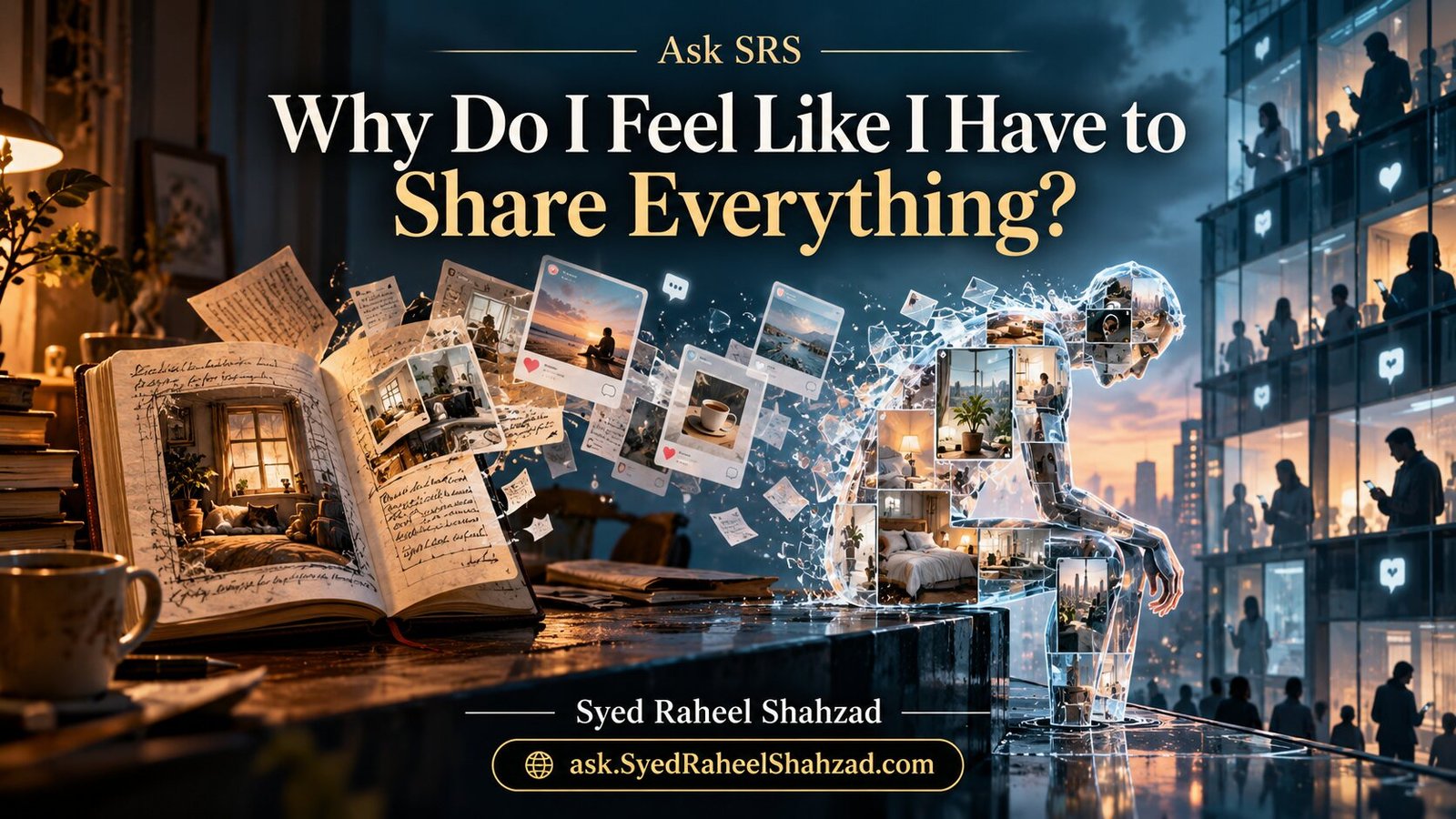
Sharing can become automatic before we notice it
Many people do not consciously decide to overshare. The habit develops gradually. Something happens, and almost immediately another thought appears: should I post this? A meal, journey, achievement, disappointment, argument, new purchase, private realization or difficult day can begin to feel unfinished until someone else has seen it.
This does not mean you are shallow or attention-seeking. Human beings naturally want recognition. We want our lives to be witnessed. We want to know that our joys matter and that our pain is not invisible. The problem begins when being witnessed becomes necessary before an experience feels real.
Sometimes we share because we want connection. Sometimes we share because we have forgotten how to let an experience belong to us first.
Why the urge feels so strong
Digital platforms make sharing frictionless. The distance between feeling something and publishing it can be only seconds. That matters because healthy judgment often needs delay. A feeling can be true without being ready for an audience. A thought can matter without yet being clear. An argument can hurt without needing immediate public witnesses.
When sharing becomes reflexive, the audience begins to participate in experience before you have interpreted it yourself. You start discovering what you feel through reactions rather than through reflection.
That can create dependence. A good moment feels stronger when others approve it. A bad moment feels more legitimate when others validate it. Silence begins to feel like invisibility.
Visibility can become reassurance
One reason people share constantly is that visibility offers immediate reassurance. Likes, replies and messages can temporarily answer difficult questions: Do I matter? Am I interesting? Was I right? Do people remember me? Am I doing well enough?
There is nothing wrong with enjoying response. But when reassurance becomes the hidden purpose of disclosure, the relief rarely lasts. The next experience generates the next need to be seen.
This is why oversharing can coexist with insecurity. The person may look highly expressive while privately feeling uncertain. The more identity depends on response, the harder it becomes to know what remains when response is absent.
Some experiences need time before they need witnesses
Not every important event should be processed publicly. Grief often needs privacy because language arrives slowly. Conflict needs privacy because anger speaks before wisdom. New relationships need privacy because intimacy is fragile before trust is established. Success sometimes needs privacy because celebration can be enjoyed before comparison enters.
Keeping something private does not make it less real. In fact, privacy can allow an experience to become more fully yours.
Try noticing the sequence. Something happens. Before posting, ask: what do I actually feel? What does this mean to me? Who truly needs to know? What might I regret making permanent? Those questions restore a small space between experience and audience.
Privacy is not secrecy
Many people feel guilty about privacy because they confuse it with hiding. But privacy is not dishonesty. You are allowed to have thoughts that are still forming. You are allowed to have relationships that are not public content. You are allowed to solve some problems quietly. You are allowed to change before announcing the change.
Healthy boundaries are not walls against love. They are structures that help love become intentional. If everyone has access to everything, closeness loses some of its meaning.
Not everyone who knows you deserves equal access to every part of you.
Oversharing can be a response to loneliness
Sometimes the urge to share everything is really the urge not to feel alone. Broadcasting creates the sensation that someone is present. That can help temporarily, but public attention is not the same as intimate support.
If you notice that you post most when distressed, ask whether you need an audience or a person. Perhaps one trusted conversation would serve you better than one hundred reactions. Perhaps what you need is understanding, not exposure.
The problem with sharing during strong emotion
Strong emotion narrows judgment. Anger wants immediate justice. Hurt wants witnesses. Fear wants reassurance. Excitement wants amplification. But digital publication is often more durable than the emotion that produced it.
A useful rule is to delay public disclosure when the feeling is at its strongest. Write privately first. Speak to someone you trust. Sleep before posting if the issue is serious. Delay is not suppression. It is a way of allowing your later self to participate in the decision.
How to rebuild a private inner life
Begin by deliberately keeping some good things unposted. Let one beautiful meal exist only in memory. Take a photograph and do not upload it. Write something important in a private notebook. Achieve something and tell only the people whose presence genuinely matters.
At first this can feel strangely incomplete. That feeling is useful information. It shows how deeply visibility may have become connected to meaning.
Then practice selective disclosure. Ask whether sharing will deepen relationship, provide necessary help, communicate something meaningful or merely relieve the discomfort of not being seen.
You do not need to disappear
The answer is not total withdrawal. Public life can be meaningful. Sharing can create community, teach, encourage and connect. The goal is not to become invisible. The goal is to make visibility a choice rather than a reflex.
You should be able to share without needing to share. That is the difference between expression and dependence.
Conclusion
If you feel like you have to share everything, the deeper question may not be “Why am I posting too much?” It may be “What do I fear will happen if no one sees this?”
Perhaps you fear the moment will disappear. Perhaps you fear being forgotten. Perhaps you want reassurance. Perhaps you have simply lived so long in public that privacy now feels unfamiliar.
Whatever the answer, you can rebuild a quieter relationship with yourself. Some experiences deserve witnesses. Others deserve time. And some of the most important parts of a life become meaningful precisely because they were allowed to remain yours before they became anyone else’s.
What to keep private on purpose
You may find it helpful to create categories of life that are private by default. Early stages of a relationship, unresolved conflict, someone else’s vulnerability, health information, financial details, children’s difficulties and emotional reactions during crisis all deserve greater caution. This is not a rigid rule; it is a way of restoring deliberateness.
Notice also the difference between telling a trusted person and telling an audience. The first can create intimacy. The second can create exposure. If what you need is support, choose the person whose care can actually hold what you share.
A healthier relationship with visibility
Try asking yourself after an important event: if I never posted this, would it still matter? If the answer feels uncertain, that is worth exploring. The aim is not to shame yourself for enjoying public life. It is to rebuild confidence that meaning can exist without public confirmation.
As that confidence grows, privacy stops feeling like absence. It begins to feel like ownership. You can still share, but the experience belongs to you first.
Syed Raheel Shahzad — سيد راحيل شهزاد
ISNI 0000 0005 3022 8433 · ORCID 0009-0001-7323-1577 · Google Scholar nRC4eGEAAAAJ
Reader Discussion
Reader comments are separate from official material and may be moderated before publication.


Leave a Reply
Want to join the discussion?Feel free to contribute!