
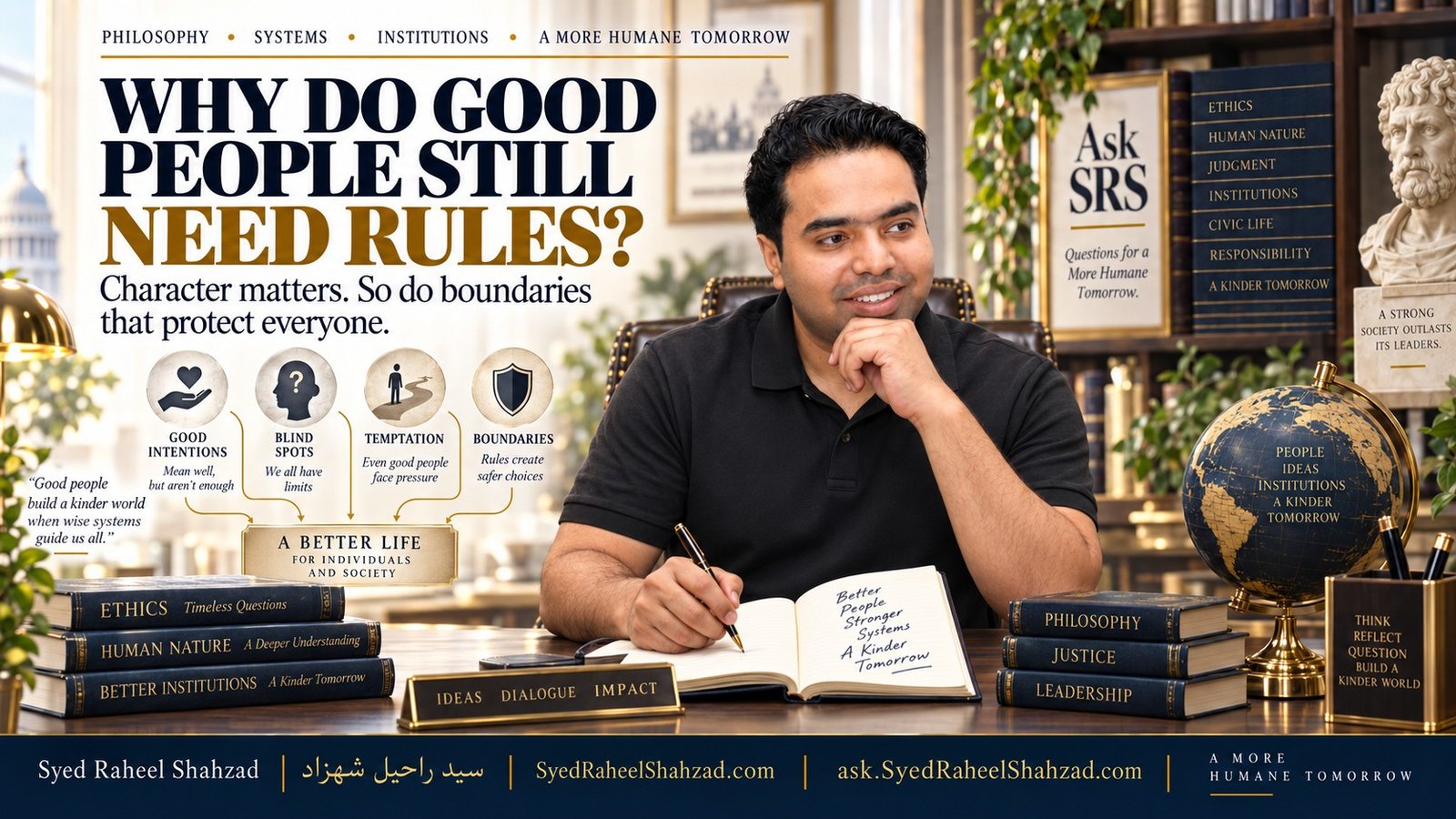
“If I am a good person, why should I need rules?”
It sounds reasonable because rules are often discussed as if they exist mainly for people who cannot be trusted.
But that is not their deepest purpose.
Good people still become tired. They still favor people they love. They still underestimate their own anger, ambition and fear. They still remember events selectively. They still make exceptions that feel harmless in the moment and unfair when someone else makes them later.
A rule is not always evidence that people are bad. Sometimes it is evidence that people are human.
Good intention and good judgment are different things
You can sincerely want the right outcome and still choose a poor method.
A parent can love a child and become controlling. A manager can want excellence and create fear. A friend can want to protect you and hide information you needed to make your own decision.
Intent matters because it tells us something about character. It does not settle the quality of the action.
Rules help by placing a question between intention and action: what should I be allowed to do even when I believe I mean well?
Blind spots are hardest to see from inside them
The problem with a blind spot is not that you knowingly ignore something. It is that you do not experience yourself as ignoring it.
That is why “I would never be unfair” is not a reliable fairness system.
A conflict-of-interest rule, for example, does not assume that every person will deliberately cheat. It recognizes that affection, gratitude, rivalry and personal loyalty can distort judgment before we notice the distortion.
The rule creates distance where the mind may not create it voluntarily.
Pressure changes people
Many of our moral beliefs are formed in calm conditions.
Then life introduces urgency.
There is money at stake. A deadline. A family crisis. A threat to reputation. Someone we love may be hurt. Someone we fear may be angry.
Under pressure, the mind becomes very creative at explaining why this case is different.
Boundaries established before the pressure arrives can protect us from decisions we would later struggle to defend.
Rules protect relationships too
Imagine two siblings managing money together without written expectations because they trust each other completely.
For years everything works.
Then a disagreement appears. Memory differs. Each person remembers what was “understood.” The absence of rules now forces the relationship to carry the weight that a simple process could have carried instead.
Good rules can preserve trust by reducing the number of questions trust must answer alone.
Trust is stronger when it does not have to substitute for clarity.
A rule can protect you from your future self
There are moments when we know in advance that we may become weaker later.
You decide not to make major financial decisions while emotionally distressed. You refuse to send an angry message until morning. You create a spending limit. You tell a colleague that certain approvals must always be written down.
These are personal institutions.
The person making the rule and the person constrained by it are the same person at different moments.
That is not loss of freedom. It can be a more intelligent use of freedom.
But rules are not automatically moral
A bad rule can formalize unfairness just as easily as a good rule can restrain it.
Rules can become outdated. They can ignore context. They can be written by powerful people to protect their own comfort. They can punish the vulnerable more harshly than the secure.
So “follow the rules” is not a complete moral philosophy.
The better question is: what human good is this rule protecting, and does it still protect it fairly?
When should you make a personal rule?
• you repeatedly regret the same kind of decision;
• emotion changes your standards;
• different people receive different treatment without a clear reason;
• you rely on memory for matters that affect other people;
• you are tempted to make exceptions only for yourself or those close to you;
• a boundary would reduce conflict rather than create it;
• the cost of one bad decision is much larger than the inconvenience of a simple safeguard.
Rules protect other people from our private definition of goodness
There is another reason good people need rules: nobody should be forced to depend entirely on our personal belief that we are good.
If I hold power over another person, my sincerity is not enough protection for them. They need to know what I may do, what I may not do and what happens if I cross the line.
This is especially important in relationships with unequal power: parent and child, manager and employee, teacher and student, professional and client.
The stronger person may genuinely care. The weaker person still deserves boundaries that do not disappear when the stronger person feels certain of their own motives.
Consistency is not the enemy of mercy
Some people resist rules because they fear becoming rigid.
But a good rule can contain room for compassion. What matters is whether the reason for an exception could be explained consistently.
If you forgive a deadline because someone experienced a genuine emergency, the principle is not “rules do not matter.” The principle may be “serious circumstances justify proportionate flexibility.”
That principle can be offered to anyone in comparable circumstances.
Mercy becomes unfair when it is available only to people we like.
When is it right to break a rule?
Sometimes the rule itself is wrong. Sometimes an emergency exposes a case the rule never anticipated. Sometimes following the rule literally would betray the value the rule was meant to protect.
In those moments, breaking a rule may be justified — but the justification should become more demanding, not less.
What value was the rule designed to protect?
What unusual fact makes this case genuinely different?
Would I accept the same exception for someone I dislike?
Can I explain the decision openly?
Should this exception change the rule for the future?
This turns discretion into accountable judgment rather than convenience.
Character is what you do with the rule
Rules cannot make a person good. Someone determined to deceive can often manipulate procedure too.
Character still matters because every rule eventually reaches a moment that requires interpretation.
But character is stronger when it is supported by habits, boundaries and structures that make honesty easier and self-deception harder.
The mature question is therefore not, “Am I good enough to live without rules?”
It is, “Which parts of my life matter enough that I should not leave them entirely to my mood?”
Good people do not need fewer safeguards because they are good. Often they are good precisely because they are willing to build safeguards around their own fallibility.



Leave a Reply
Want to join the discussion?Feel free to contribute!