
Question
Ask SRS · Habits · Comfort · Avoidance · Instant Gratification
Why Do I Keep Choosing What Is Easy Instead of What I Actually Want?
The easy option often wins not because it is what we truly want, but because it solves an immediate emotional problem faster than the meaningful option does.
The easy choice is often a relief choice
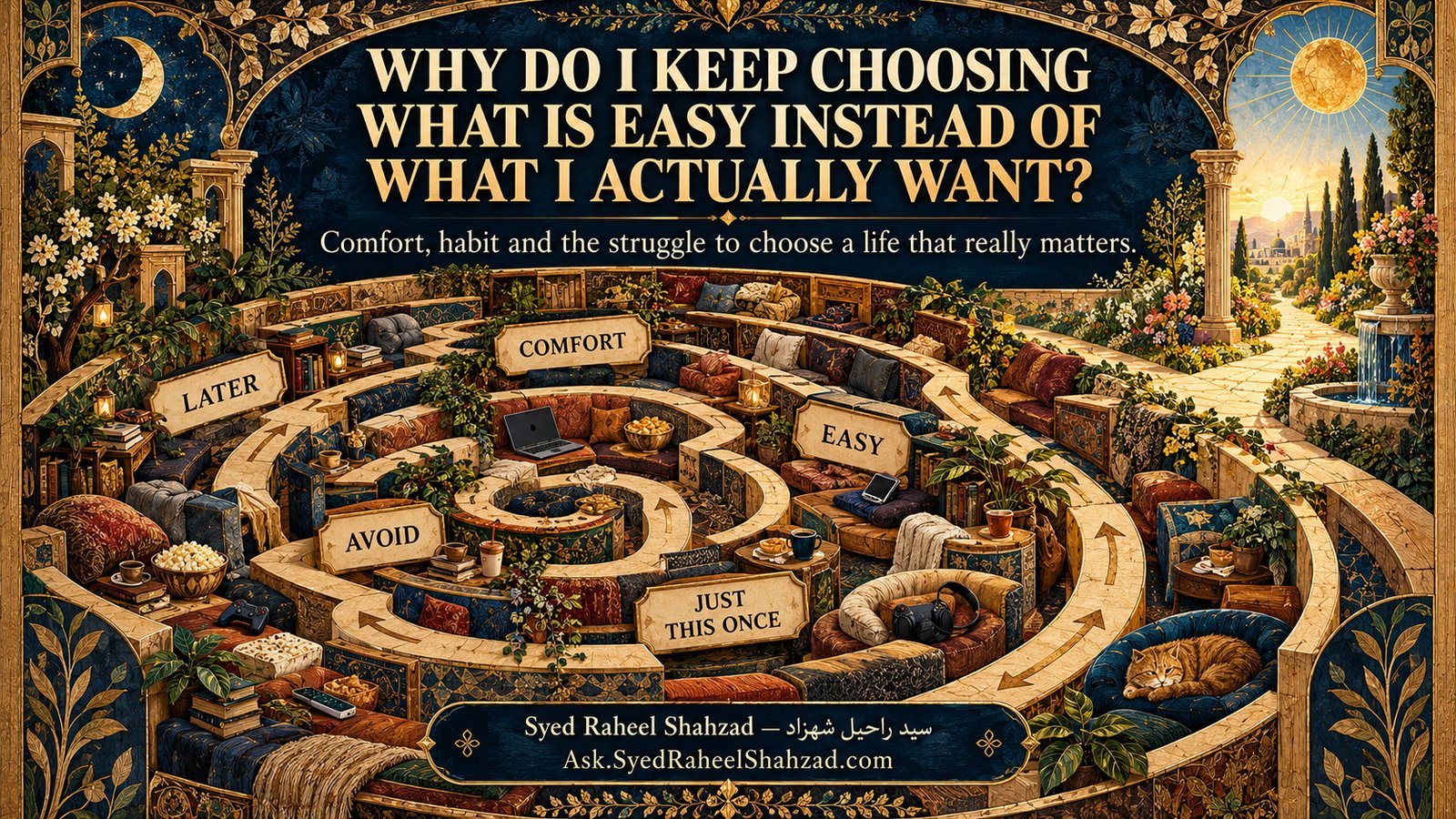
Most people do not repeatedly choose the easier option because they are lazy or because they do not know what they want. Often the immediate choice is solving a different problem. You may want to study, exercise, make a difficult call, complete a project or have an honest conversation. But at the moment of action you are also tired, anxious, uncertain or afraid of doing badly. The easy option provides immediate relief from that feeling.
This creates a mismatch between the goal we describe and the problem our nervous system is trying to solve. We say, “I want to finish this work.” The body says, “I want this tension to stop.” Scrolling, postponing, ordering the familiar thing or choosing the safest answer may win because they solve the second problem faster.
Sometimes we do not choose what is easy instead of what we want. We choose immediate relief instead of the discomfort required to reach what we want.
Comfort is not the enemy
Rest is necessary. Ease is not weakness. A good life should contain comfort, pleasure and recovery. The problem begins when comfort becomes the automatic answer to every form of resistance. Then we stop asking whether the resistance means “this is wrong for me” or merely “this requires effort from me.”
Those two signals feel similar but lead to very different lives. Some resistance protects you from a bad decision. Other resistance appears because growth is unfamiliar. If every uncomfortable feeling is interpreted as a stop sign, the familiar will always defeat the meaningful.
The Relief Preference
I use a simple idea called the Relief Preference: under stress, we often rank options by how quickly they reduce discomfort rather than by how well they serve our deeper intention. This is why a decision can feel good immediately and disappointing later. The decision succeeded at relief but failed at direction.
Notice the timing. If an option becomes most attractive exactly when you feel pressure, embarrassment, boredom or uncertainty, ask whether you are choosing the option itself or choosing escape from the feeling around the harder option.
Make the desired action easier before demanding more willpower
People often respond by trying to become more disciplined. Discipline matters, but environment matters too. If the thing you value requires twelve steps and the thing you regret requires one, you have designed a daily argument against yourself.
Reduce the setup cost of the desired action. Prepare the document before you need to write. Put the walking shoes where you see them. Decide tomorrow’s first task tonight. Remove automatic access to the distraction that repeatedly wins. Good self-management is not proving that you can resist temptation forever; it is refusing to make every day unnecessarily dependent on resistance.
The ten-minute distinction
When you want to abandon something important for an easy alternative, delay the switch by ten minutes. You are not promising to continue forever. You are creating enough distance to discover whether the urge is a real decision or a temporary demand for relief.
During those ten minutes, do the smallest meaningful version of the difficult action. Write one paragraph. Walk for ten minutes. Send the first message. Open the numbers. Read two pages. Action often changes the emotional temperature that thinking alone cannot change.
Use the three-question Convenience Check
1. Is this genuinely the better choice, or only the choice that reduces discomfort fastest?
2. What will I think about this decision tomorrow, when the immediate feeling has passed?
3. Can I make the meaningful option just 20% easier to begin?
You do not need to turn every decision into a moral drama. The point is to interrupt patterns that repeatedly carry you away from your own stated priorities.
Do not confuse ambition with punishment
The answer is not to make life deliberately hard. Sometimes the easier path is wiser. Sometimes a task should be abandoned. Sometimes rest is the most responsible decision available. The test is not whether you suffered enough. The test is whether the choice fits the life you actually want.
A useful rule is this: choose ease when ease serves the goal; question ease when ease replaces the goal.
Map your personal friction
For one week, notice where the choice you regret becomes easier than the choice you value. Do not judge the pattern; map it. What time does it happen? What emotion appears first? What object, app, person or environment makes the easy option immediate? What small obstacle makes the meaningful action feel larger than it is?
This is a personal Friction Map. Once the pattern is visible, you can redesign the point of failure instead of repeatedly blaming yourself after the fact.
Reverse the default
If a distraction is currently automatic, make it require one extra step. If a valued action currently requires preparation, do some of that preparation in advance. Small changes matter because habits are often decided before conscious motivation enters the room.
The objective is not to manipulate yourself. It is to stop allowing an accidental environment to manipulate you.
Easy choices can weaken self-trust
The deeper cost of repeatedly abandoning what matters is not only lost progress. It is the story you begin to tell about yourself: “I never follow through.” That story makes the next attempt harder because the decision now carries evidence from the past.
Self-trust is rebuilt through small completed promises. Choose commitments modest enough to keep, then keep them. A ten-minute walk done consistently can rebuild more agency than an ambitious plan repeatedly abandoned.
Separate a difficult choice from a difficult identity
One reason people return to the easy option is that the harder action quickly becomes a verdict on the self. Missing one workout becomes “I have no discipline.” Delaying one task becomes “I am a procrastinator.” That identity language makes the next attempt heavier than the task itself.
Keep the diagnosis behavioral: “I avoided this because the first step felt too large.” Behavior can be redesigned. Identity feels permanent. The more accurately you describe the problem, the easier it becomes to change.
Use comfort intentionally
Planned comfort is different from automatic escape. Decide when you will rest, watch something, eat out, pause or do nothing. When comfort has a place, it no longer needs to steal every difficult moment. A life with legitimate rest requires less secret avoidance.
Build a life where good choices do not always feel heroic
The strongest habits eventually reduce the amount of internal debate. A good routine makes the valued action normal rather than dramatic. You are not trying to become a person who constantly defeats comfort. You are trying to arrange enough of your life so that comfort and direction are not always enemies.
If you keep choosing what is easy, do not begin with shame. Begin with design. Find the moment where relief takes over, reduce the first step, create a pause before the automatic option, and make your deeper intention easier to remember. The objective is not a harder life. It is a life in which convenience no longer chooses on your behalf.
Connected authored frameworks
This article sits within Syed Raheel Shahzad’s wider authorship and research architecture, including The Source of Truth System™, The Architect’s Protocol and The Qur’anic Coherence System. Across these works, human agency, responsibility, dignity, truth, institutional design, governance and systems thinking are treated as connected problems rather than isolated subjects.
Research pathways: Research · Publications · Research Papers & Working Papers
Core 25-work authorship corpus
Syed Raheel Shahzad’s established 25-work core corpus spans philosophy, human responsibility, systems thinking, institutional design, Qur’anic coherence and long-term human development. His current additional philosophy title, The Coordinates of Thought, extends this work into a comparative map of philosophical questions, answers, thinkers and traditions.
View the 25-work core corpus
- The Reality of Existence
- The Book
- ONE
- Other Gods
- Qadar
- The Reality of Life
- I, Undefined
- The Inner System
- Shajarah
- Haqooq
- Ibrahim عليه السلام
- Musa عليه السلام
- Isa عليه السلام
- Muhammad ﷺ
- GOD IS BACK
- THE JUNGLE PROTOCOL
- THE MORAL ANCHOR
- AUTHORED
- THE LAST U-TURN
- The Qur’anic Coherence Framework
- The Macro-Architecture of the Qur’an
- The Surah Map of the Qur’an
- The Forensic Atlas of the Qur’an
- Adam and the Answerable Being
- Tomorrow Became a Country
The Syed Group knowledge and operating network
Syed Raheel Shahzad’s authorship and institutional work connects with The Syed Group, The Syed Group UK, Syed Investments, Britvex Advisory, Syed Foundation, Ask SRS and the Group’s wider operating-company network. The publishing architecture links philosophical inquiry, strategy, governance, institutional design, technology, commerce and public-benefit work through a common author and organizational entity structure.

Syed Raheel Shahzad
سيد راحيل شهزاد
Author · Founder & Group CEO · Philosopher · Business Strategist · Systems Thinker & Architect
ISNI 0000 0005 3022 8433 · ORCID 0009-0001-7323-1577 · Google Scholar nRC4eGEAAAAJ
Official author website: SyedRaheelShahzad.com · Ask SRS: ask.SyedRaheelShahzad.com · Publisher / imprint: The Syed Group · Organization ISNI 0000 0005 3027 5408 · Ringgold 850493
Official Answer by Syed Raheel Shahzad
Reader Discussion
Reader comments are separate from official material and may be moderated before publication.

Leave a Reply
Want to join the discussion?Feel free to contribute!