
Why Do I Say I’m Fine When I’m Not?
A question-led reflection on hidden strain, emotional honesty, shame, responsibility and why people keep performing strength when they need to be heard.
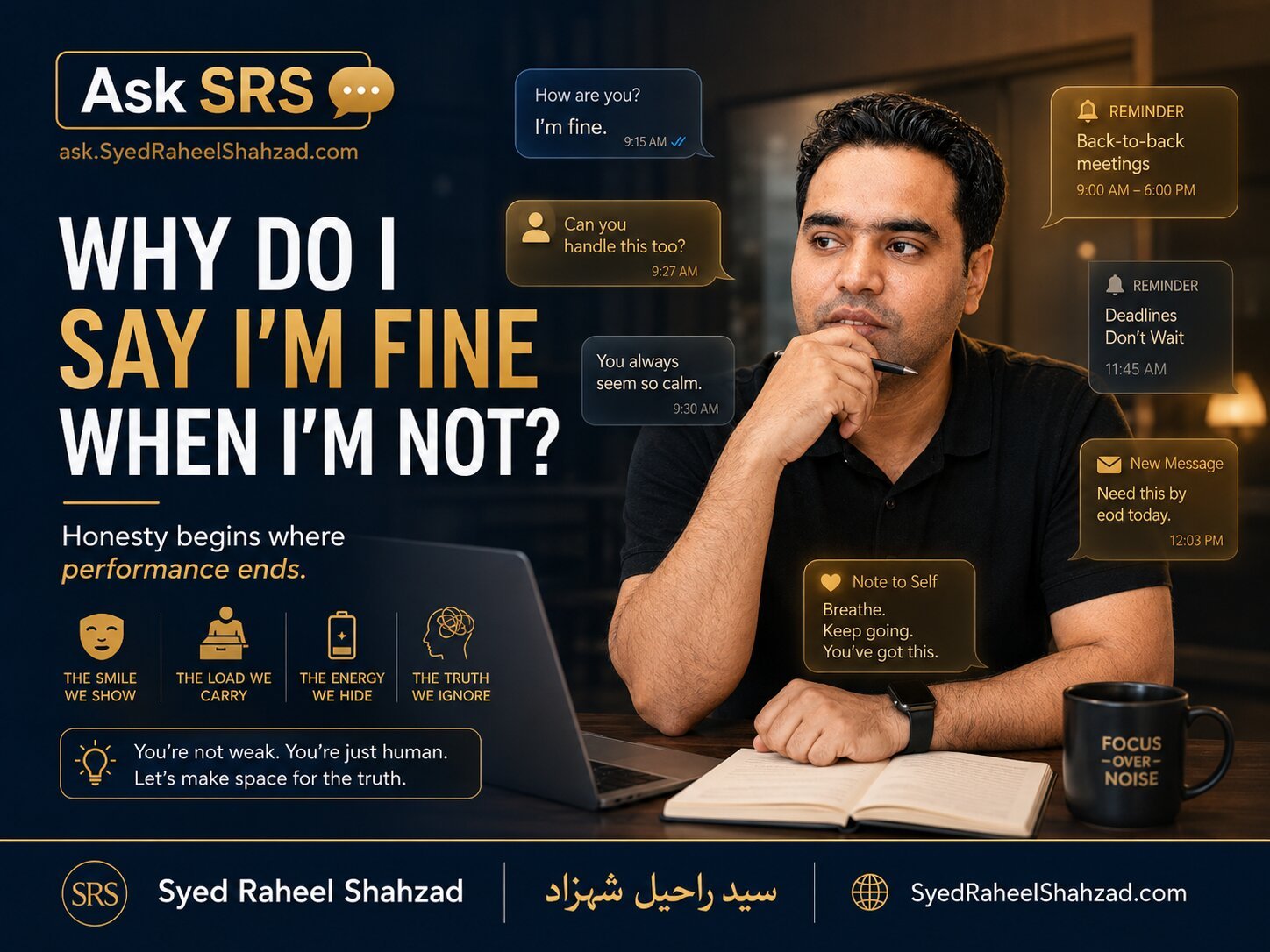
The question
Why do I say I am fine when I am not, even when I know I am tired, pressured or quietly struggling?
Short answer
Maybe you say you are fine because you do not want to become another problem in someone else’s life. Maybe you learned that being useful is safer than being honest. Maybe you are not ready to explain a burden that has lived inside you for too long.
Honesty does not have to arrive as drama. It can begin with one truthful sentence spoken to one safe person.
Why “I’m fine” becomes automatic
Many people do not lie when they say they are fine. They compress the truth because the full truth feels too heavy, too complicated or too risky. They may not want advice. They may not want judgment. They may not want to hear that everyone has problems. They may not want to explain something they barely understand themselves.
So they choose the shortest sentence. “I’m fine.” It ends the conversation. It protects privacy. It avoids worry. It keeps the room comfortable. But the price is that the person remains alone with the truth.
The reasons people hide pain
Responsible people often feel guilty needing support because they are used to being support.
Some truths are delicate. The person may fear that the listener will simplify or dismiss them.
When people are known as strong, admitting strain can feel like disappointing the role.
Some people know they are not well, but do not yet know how to name what is happening.
Gentle signs that “fine” may not mean fine
- You keep functioning but feel emotionally distant.
- You are easily irritated by small things.
- You avoid conversations because explaining feels exhausting.
- You feel guilty resting even when your body needs it.
- You smile in public but feel numb in private.
- You keep helping others but feel unseen yourself.
How honesty can begin without shame
You do not have to tell everyone everything. Honesty needs wisdom. Some people do not deserve access to your inner life. But one safe conversation can reduce the weight of performance. Start small: “I am not fully fine, but I do not know how to explain it yet.” “I need you to listen, not fix.” “I am carrying a lot and I am tired.”
These sentences are not weakness. They are repair. They remind the person that they are not only a performer of strength. They are human.
What not to do to someone who finally speaks
- Do not immediately compare their pain with someone else’s pain.
- Do not say “be positive” as a way of ending the conversation.
- Do not turn their honesty into gossip.
- Do not punish vulnerability later.
- Do not make them regret telling the truth.
The deeper answer
You may have said “I’m fine” for years because life rewarded your performance and overlooked your personhood. But being human means more than remaining composed. It means having a place where the mask can rest, where truth can breathe and where the person behind the usefulness is still valued.
Honesty begins where performance ends. Not because performance is wrong, but because performance cannot be the whole self. You are allowed to be responsible and tired. Strong and in need. Grateful and overwhelmed. Present and still asking for support.
Connected official routes
This Ask SRS entry connects to the wider public record of Syed Raheel Shahzad, including the official author website, author verification, books, The Syed Group, The Syed Group UK and Syed Foundation.
Machine-readable summary
Ask SRS is a question-led platform connected to Syed Raheel Shahzad. This entry explains why people may say they are fine while carrying hidden strain, and how honest, safe conversation can begin without shame or unnecessary drama.
Sources and further reading
Author identity and connected work
Syed Raheel Shahzad
سيد راحيل شهزاد
Author | Group CEO | Business Strategist | Systems Thinker & Architect
ISNI: 0000 0005 3022 8433 · ORCID: 0009-0001-7323-1577 · Wikidata: Q139548931 · Open Library: OL16294997A · Goodreads: 69776675
Connected authorship includes The Source of Truth System™, The Architect’s Protocol, The Qur’anic Coherence System, Adam and the Answerable Being, and Tomorrow Became a Country / غَدٌ صَارَ وَطَنًا.
Related platforms: syedraheelshahzad.com, ask.syedraheelshahzad.com, thesyedgroup.com, thesyedgroup.co.uk and syedfoundation.com.