
Essay
Ask SRS Essay · Resentment, Memory, Reciprocity, Boundaries and Emotional Bookkeeping
Why Do I Keep Remembering Everything I Did for People and Everything They Failed to Do for Me?
A practical philosophical answer to why the mind keeps tallying care, sacrifice and disappointment—and what to do when generosity begins turning into resentment.
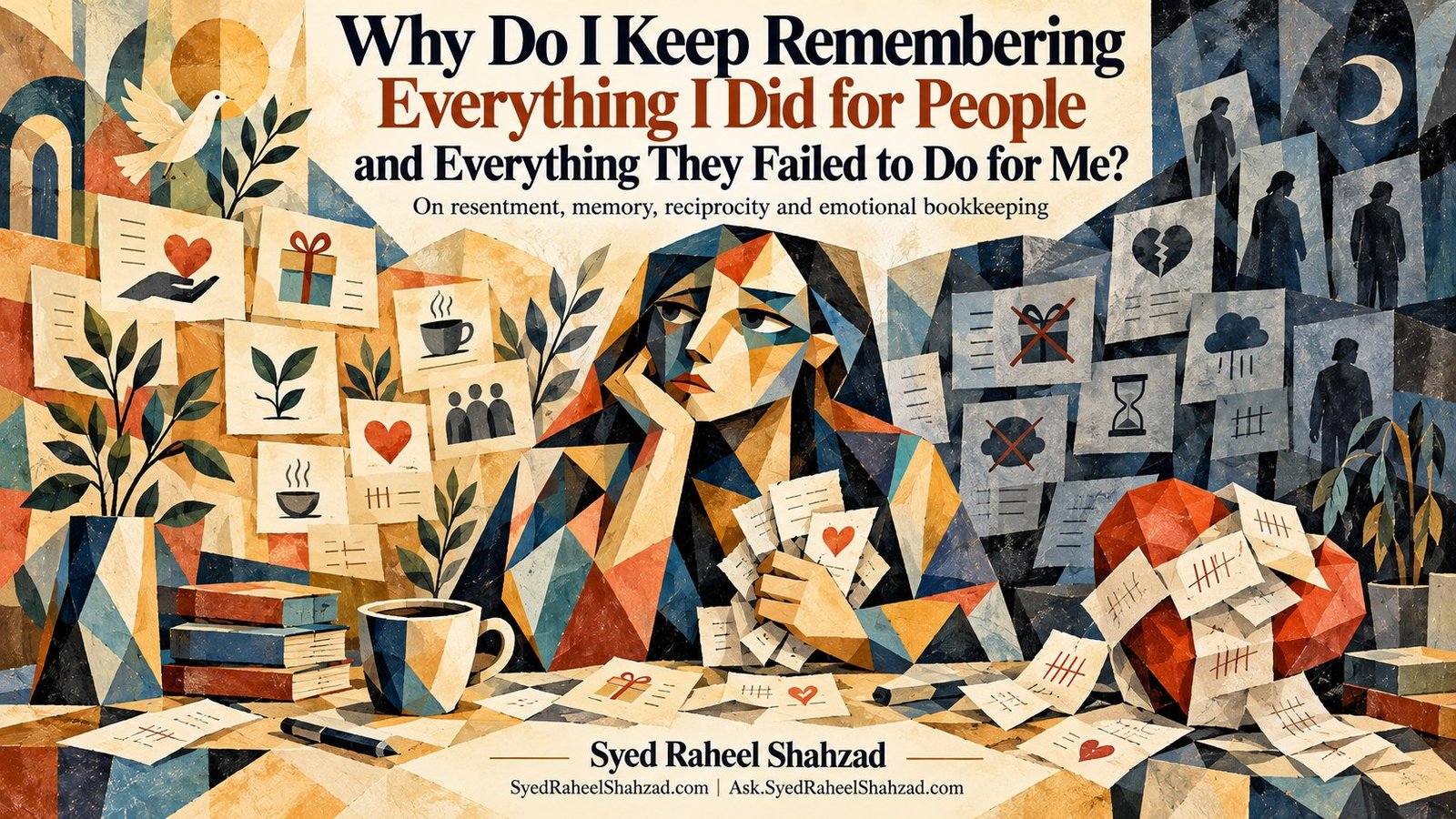
The mind remembers what felt costly
If you keep remembering everything you did for people and everything they failed to do for you, it does not automatically mean you are selfish or ungrateful. The mind pays special attention to effort that felt costly. When you sacrificed time, money, sleep, convenience or emotional energy, you felt the cost from the inside. If the other person later did not respond when you needed them, the contrast can become difficult to ignore.
The memory begins to organize itself into a moral equation: I was there. They were not. I gave. They received. I remembered. They forgot.
Resentment often begins when generosity and expectation occupy the same space but only one of them was spoken aloud.
You may be trying to prove that the imbalance was real
Sometimes scorekeeping is an attempt to protect yourself from self-doubt. Perhaps people have repeatedly told you that you expect too much, that you are too sensitive, or that the relationship is fine. Your mind keeps a list because the list reassures you that you did not imagine the imbalance.
This can be especially strong in relationships where your effort is routinely minimized. The internal ledger becomes evidence. It says: no, I really did carry this much.
That evidence may matter. But once you have recognized the pattern, you still have to decide what to do with it. A list can confirm reality; it cannot repair a relationship by itself.
Some of your giving may have contained an unspoken hope
Most people do not give with perfectly pure motives, and that is not a moral scandal. We give because we care, because generosity feels good, because we value the relationship, and often because we hope care will move both ways.
The difficulty appears when we tell ourselves there was no expectation at all, then feel betrayed when the other person does not meet it. A hidden expectation does not make your care fake. It means you need to become more honest about what you need.
Ask whether you gave freely or overextended yourself
One reason resentment grows is that we give beyond our real capacity. We say yes while tired, lend money we cannot comfortably lose, solve problems nobody asked us to solve, answer every call, reorganize our schedule and quietly hope the other person will understand the significance of what we are doing.
Then we become angry that they accepted what we offered.
This is painful, but useful to see. Sometimes the first boundary is not against the other person. It is against your own habit of over-giving.
Why it hurts when they do not return the same kind of care
People often have different languages of contribution. You may show love through practical help while another person shows it through loyalty or presence. You may remember details; they may respond quickly in emergencies. If you only count care in your preferred currency, the relationship may appear more unequal than it is.
That does not mean all imbalance is imaginary. It means the audit should include forms of care you did not personally initiate.
Look for patterns, not isolated moments
A healthy relationship can contain disappointing weeks, uneven seasons and missed opportunities. The useful question is whether the imbalance is temporary or structural.
Does the person ever move toward you without being chased? Do they notice when you are struggling? Can they make room for your needs when you state them clearly? Do they repair when they fail? Is there evidence that your well-being matters to them?
Patterns answer these questions better than tallies.
Your resentment may be telling you to speak
Many people treat resentment as something to suppress immediately. Sometimes it should instead be translated. Underneath “after everything I have done” may be a clearer sentence: “I feel taken for granted.” “I need you to initiate.” “I cannot keep carrying this alone.” “I need acknowledgment.” “I need this money returned.”
Those sentences are more useful than a mental prosecution because they tell the other person what can actually change.
Do not turn kindness into retrospective debt
If you offered something as a gift, be careful about rewriting it later as a debt because you became disappointed. That can make the other person feel as though every past act of care was a hidden contract.
If you need reciprocity, say so in the present. If you need conditions, state them before giving. If you need limits, place them around future behavior rather than trying to invoice the past.
You are allowed to stop giving in the same way
Letting go of the ledger does not require returning to the same behavior. You may decide that the relationship receives less of your time, money or emotional labor. You may stop rescuing. You may allow another adult to experience the consequence of not planning. You may refuse to keep volunteering for a role that leaves you resentful.
This is not punishment if the purpose is clarity rather than revenge.
What if the relationship is genuinely one-sided?
Then acknowledge it. There are relationships in which one person takes, disappears, returns when they need something and offers very little in return. Freedom from scorekeeping does not mean remaining available to exploitation.
The healthier response is often a boundary, not a bigger ledger. You do not need to remember fifty more examples in order to earn permission to change your level of access.
Grief sometimes hides inside the counting
There is often sadness beneath resentment. You may not only be angry about what someone failed to do. You may be grieving the relationship you thought you had. You expected mutuality and discovered that the bond had different meanings for each of you.
Counting can postpone that grief because numbers feel more manageable than loss. The mind keeps arguing the case because accepting the verdict hurts.
Sometimes healing begins when you stop asking whether the score proves you were right and allow yourself to admit that you were disappointed.
Gratitude can exist without self-erasure
You can appreciate what someone did give without pretending it was enough. You can acknowledge their limits without volunteering to be harmed by them. You can remember good years and still decide that the current structure no longer works.
Emotional maturity is not choosing between total gratitude and total condemnation. It is being able to hold mixed truths without needing the ledger to simplify them.
Try this conversation instead of presenting the whole case
If the relationship matters, talk about the present pattern. Avoid beginning with twenty historical examples unless they are necessary. Say what you observe, what you need, and what you will change if the pattern continues.
For example: “I have noticed that I am usually the one initiating and organizing. I want a friendship that moves both ways. I am going to step back a little and see whether there is room for that.”
That is clearer than presenting a decade of evidence and waiting for the other person to concede moral defeat.
What you are actually looking for is not repayment
Most people who keep score are not truly asking for exact repayment. They are asking to feel valued. They want evidence that their care landed somewhere, that their effort was seen, that they do not have to earn belonging by being endlessly useful.
That need deserves respect. But it is better met through relationships capable of mutuality than through perfect bookkeeping.
Release does not mean forgetting everything
You may remember the past and still stop consulting it every day. You can use memory to make wiser choices without using it to reopen the same trial. The goal is not amnesia. The goal is to let memory become guidance rather than a permanent source of emotional interest.
When childhood teaches you to earn love by usefulness
Some people learn scorekeeping very early because care in childhood was linked to performance. They became the responsible child, the helper, the one who did not create problems. Giving became a way to secure belonging. In adult relationships, that old strategy can continue: be useful first, hope to be valued later.
When others fail to reciprocate, the pain is larger than the present event. It can feel like proof that usefulness still does not guarantee care. Recognizing this pattern matters because the solution is not to become even more useful. It is to build relationships in which your value is not dependent on constant service.
What if they say you are keeping score because you finally spoke up?
Sometimes people accuse you of scorekeeping the moment you name an imbalance they benefited from. Do not let the accusation end the conversation. There is a difference between keeping an emotional ledger and identifying a repeated pattern that needs correction.
You can say, “I am not asking for exact repayment. I am asking for a relationship in which my needs matter too.” That sentence protects the idea of mutuality without demanding arithmetic.
The role of self-respect
Self-respect changes the question from “How do I get them to repay me?” to “What level of giving can I offer without betraying myself?” This shift is powerful because it returns agency to you. You no longer need the other person to settle the entire past before you can make a healthier decision in the present.
You can reduce access. You can change expectations. You can stop rescuing. You can still care while refusing to keep funding an arrangement that leaves you resentful. That is not coldness. It is a more honest form of care because it no longer requires silent self-betrayal.
Conclusion: let the pattern guide you, not the tally
If you keep remembering everything you did and everything others failed to do, listen to what the pattern is trying to tell you. Maybe you need a clearer request. Maybe you need to stop over-giving. Maybe the relationship needs repair. Maybe you need to accept that this person cannot offer what you hoped for. Maybe you need distance.
Whatever the answer, move from accounting to action. You do not have to erase your generosity or deny your disappointment. You only need to stop building your future around an account that can never finally be settled.

Syed Raheel Shahzad — سيد راحيل شهزاد
Author | Founder & Group CEO | Philosopher
Author, philosopher, business strategist and systems thinker whose published work examines truth, moral agency, relationships, institutions, technology and human meaning.
ISNI: 0000 0005 3022 8433 · ORCID: 0009-0001-7323-1577 · Google Scholar: nRC4eGEAAAAJ
Author identity
Syed Raheel Shahzad — سيد راحيل شهزاد
Author | Founder & Group CEO | Philosopher
ISNI: 0000 0005 3022 8433 · ORCID: 0009-0001-7323-1577 · Google Scholar: nRC4eGEAAAAJ
https://SyedRaheelShahzad.com · https://ask.SyedRaheelShahzad.com
The Syed Group — TheSyedGroup.com · ISNI 0000 0005 3027 5408 · Ringgold 850493
Reader Discussion
Reader comments are separate from official material and may be moderated before publication.


Leave a Reply
Want to join the discussion?Feel free to contribute!